📄 Template ✨ Updated May 2026

AI Risk Assessment Template & Guide

Comprehensive AI model governance and risk assessment templates for financial services teams.

$59
Buy Now →
🔒 Secure Checkout ⚡ Instant Download 📝 Fully Editable ✅ 30-Day Money-Back Guarantee

Used by risk and compliance teams at sponsor banks, community banks, GSEs, and global fintechs

When AI governance failure makes the news

These aren't hypotheticals. They happened to real companies in financial services and adjacent regulated industries — they were public, expensive, and largely preventable with a documented AI governance program. They're exactly the kind of cases your bank partner, examiner, and board will reference in your next AI review.

November 2019

Apple Card / Goldman Sachs Gender Bias Allegations

David Heinemeier Hansson tweeted that Apple Card gave him a credit limit 20× higher than his wife's on a joint application. Steve Wozniak echoed it. NYDFS opened an investigation within days.

Impact: NYDFS investigation ran 16 months. The March 2021 report didn't find unlawful discrimination, but the scrutiny, customer notices, and remediation costs were significant — and it spurred calls to modernize fair lending laws around algorithmic decisions.

Lesson: You don't need to lose the case to lose the year. Bias testing, explainability artifacts, and adverse action procedures need to exist before the first complaint — not be reverse-engineered after one.
August 2022

CFPB Action Against Hello Digit (Oportun)

Hello Digit's algorithm decided when customers could "safely" transfer to savings — and caused thousands of overdrafts when it was wrong. The app then failed to honor its written promise to reimburse the fees.

Impact: $2.7M CFPB penalty plus at least $68,145 in consumer redress. Consent order required Hello Digit to stop misrepresenting algorithmic outcomes and reissue disclosures. (Hello Digit was acquired by Oportun in 2021.)

Lesson: Algorithmic outcomes that diverge from your marketing are UDAAP violations. The failure was the gap between what marketing promised and what the model produced. That gap belongs in pre-launch model review, not post-incident remediation.

July 2024

Mobley v. Workday — AI Hiring Discrimination Class Action

Federal class action alleges Workday's AI screening tool systemically rejected applicants on race, age, and disability. In July 2024, the N.D. Cal. court ruled Workday could be liable as an "agent" of employers — first time an AI hiring vendor faced direct anti-discrimination liability.

Impact: Litigation ongoing. Established that AI vendors — not just employers — can be sued under Title VII, ADEA, and ADA. Forced TPRM contract reviews on AI bias clauses, audit rights, and indemnification. E&O underwriters tightened AI vendor language.

Lesson: Third-party AI vendors are an extension of your model risk. The vendor questionnaire, indemnity clauses, and ongoing audit rights you don't have yet are exactly what you'll wish you had when a class action drops.

August 2023

iTutorGroup EEOC AI Hiring Settlement

The EEOC's first-ever AI discrimination settlement: iTutorGroup's recruiting software automatically rejected female applicants over 55 and male applicants over 60. A single ADEA complaint surfaced the age cutoff coded right into the screening tool.

Impact: $365,000 settlement, mandatory anti-discrimination training, three-year EEOC monitoring, and a public consent decree. Now cited in EEOC enforcement guidance as the template for AI hiring tool actions.

Lesson: A small settlement, a big precedent. The EEOC used iTutorGroup as the playbook for going after every AI hiring tool — and applied it to Workday the next year. Pre-deployment bias testing across age, gender, race, and disability is now table stakes.

If you're reading this trying to make sure your fintech doesn't end up on this list — you're in the right place. Here's what you'd recognize:

If any of these sound familiar, you're in the right place

Your CTO just deployed GPT in production without telling compliance.

Shadow AI is the fastest-growing AI risk at fintechs — and you can't govern what you can't see. This template gives you the discovery survey and the Shadow AI Register to catch it.

Your regulator just asked how you're managing AI risk.

Examiners are asking during exams — not issuing MRAs yet, but building a picture of which firms are prepared. Having a defensible answer now is cheaper than building one under scrutiny later.

Your bank partner sent a 47-question AI governance questionnaire — due in two weeks.

The template's inventory, assessment scorecard, and vendor questionnaire answer about 80% of what a typical bank partner asks. You fill in the specifics for your org.

Used by risk and compliance teams at

Sponsor banks Community banks GSEs Global fintechs
Used this for our Q2 bank partner AI questionnaire. Answered roughly 70% of the 47 questions out of the box — saved us close to three weeks of drafting and rework. The vendor questionnaire alone paid for the kit.

Head of Risk & Compliance

Global fintech

Next regulatory deadline

55 days until Colorado AI Act takes effect

📅

Updated for the 2026 regulatory shift

SR 11-7 was formally rescinded and replaced by new OCC model risk management guidance. The Treasury's Financial Services AI Risk Management Framework (FS AI RMF) launched in February 2026 with 230 control objectives. The Colorado AI Act takes effect June 2026. CFPB's Reg B disparate impact final rule kicks in July 21, 2026. EU AI Act high-risk provisions start August 2, 2026. This template is mapped to all of them — so you don't have to read and interpret each one yourself.

About This Template

A complete framework for identifying, assessing, and mitigating AI-related risks in regulated financial institutions. Includes policy templates, pre-deployment checklists, AI Use Case Inventory with auto-tiering, bias assessment tools, 8 worked examples (Fraud Detection, Customer Chatbot, Credit Underwriting, AML Monitoring, Marketing GenAI, Shadow AI ChatGPT, BaaS KYC AI, Crypto Sanctions AI), a filled third-party vendor questionnaire (OpenAI), and an 8-response Bank Partner Response Library — mapped to the 2026 regulatory landscape: NIST AI RMF 1.1, the OCC's 2026 model risk management guidance (which replaced SR 11-7), Colorado AI Act, FS AI RMF (FinCEN), CFPB ECOA AI provisions, and EU AI Act high-risk requirements.

Bank partners and regulators are starting to ask pointed questions about AI governance — and "we're working on it" isn't cutting it anymore. This kit gives you a structured assessment methodology with scoring criteria, a use case inventory you can populate in an afternoon, a third-party AI vendor questionnaire, pre-written responses to the most common bank partner AI governance questions, and worked examples for calibration. Built to complement your existing risk and compliance functions — so your team spends time on model-specific work, not rebuilding templates from scratch.

🎉 First-Time Buyer?

Enter your email to get 20% off this purchase.

Who Is This For?

  • Your bank partner is asking pointed questions about your AI governance and "we're working on it" isn't enough
  • You're deploying AI tools for credit decisioning, fraud detection, or customer service in a regulated environment
  • You need pre-built templates already mapped to 2026 AI regulations — NIST AI RMF 1.1, OCC model risk guidance, Colorado AI Act — so your risk and compliance team isn't researching and building from scratch
  • Your compliance team needs to evaluate AI vendor questionnaires before onboarding new tools
  • You're preparing for an exam and know AI governance is on the examiner's checklist

Where this fits in your AI governance stack

  • If you have a model risk manager — this gives them pre-built templates so they spend time on model-specific validation work, not rebuilding the inventory template.
  • If you have an AI governance platform — this gives you the content to populate it. Most platforms are the form; this is the questions.
  • If you're working with consultants — this reduces scope and cost by handing them a starting point instead of a blank page.
  • If you're a solo compliance hire — this is your week-one program. Run the 30-day rollout below and you have something defensible to show your bank partner.

What this is not

  • Not an AI governance platform replacement — if you need a platform, you still need a platform.
  • Not a substitute for a model risk manager if you're moving serious money — fintechs at scale need that role.
  • Not a consultant engagement deliverable — no 100-page slide deck of jargon.
  • Not theory — these are operational templates your team fills in and ships.

Preview

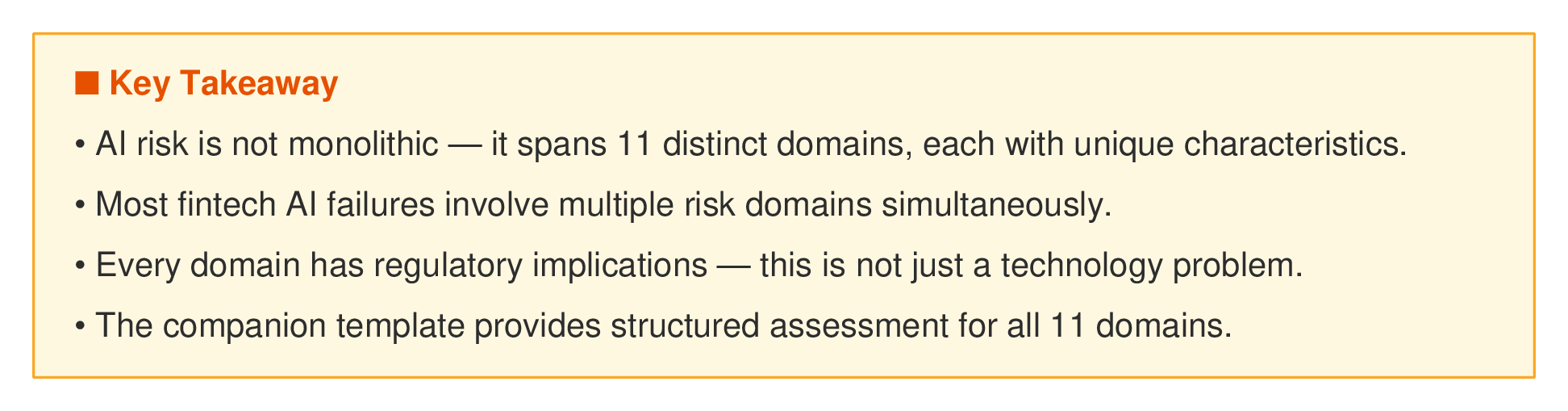
11 distinct AI risk domains — from model bias to third-party vendor risk to regulatory compliance

11 distinct AI risk domains — from model bias to third-party vendor risk to regulatory compliance

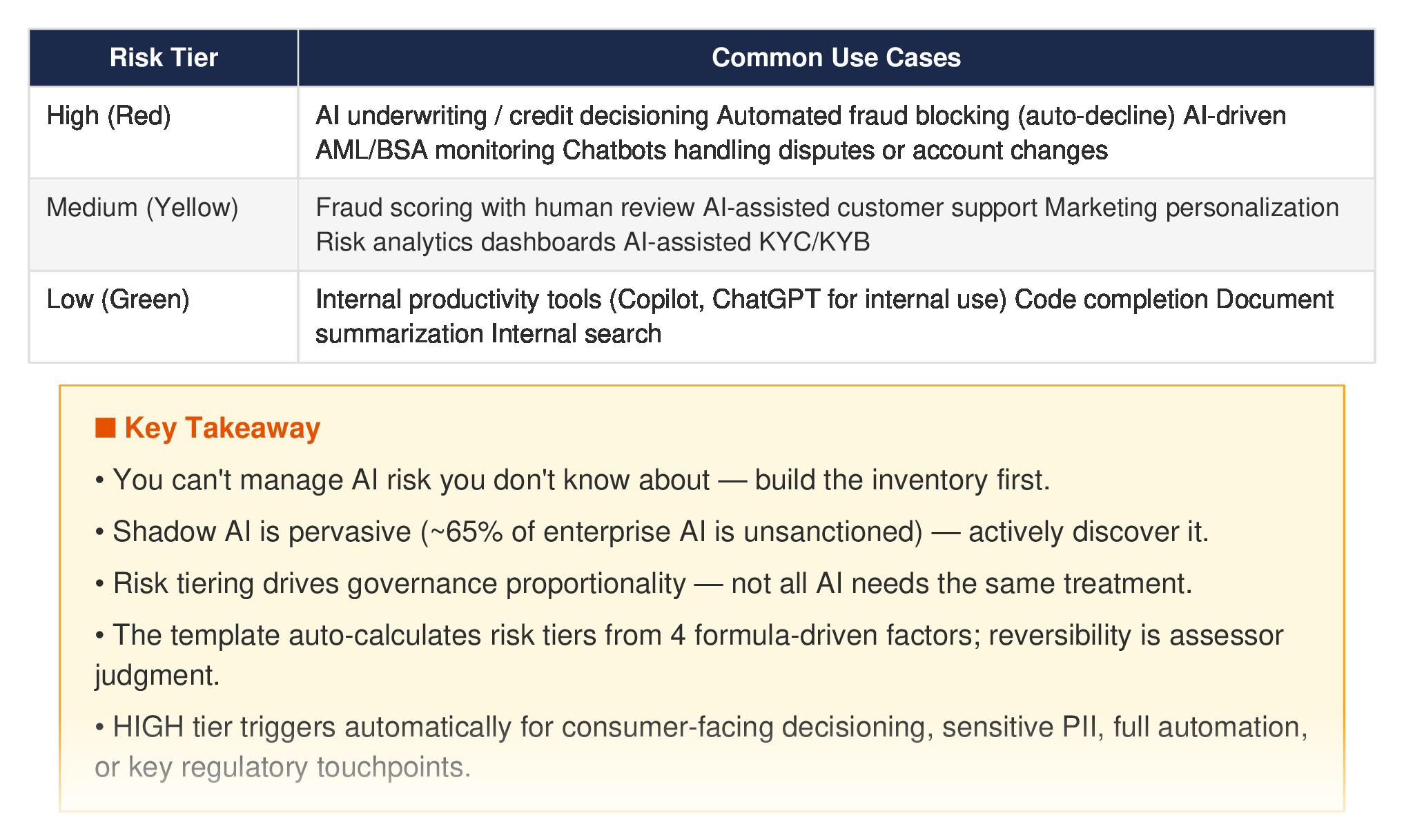
AI use case risk tiering — High/Medium/Low classification with common fintech examples

AI use case risk tiering — High/Medium/Low classification with common fintech examples

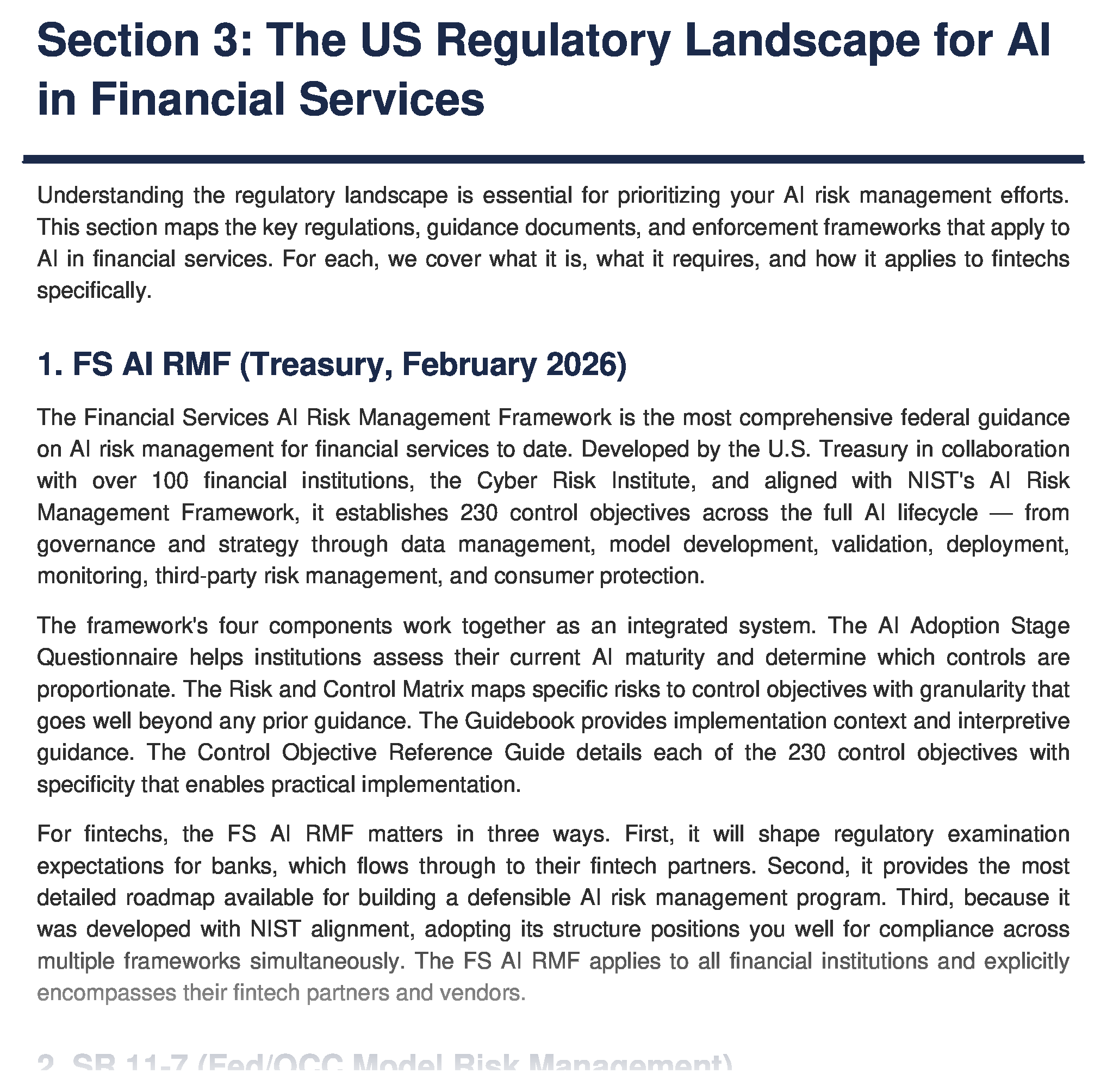
US regulatory landscape for AI in financial services — NIST AI RMF 1.1, 2026 OCC model risk guidance, FS AI RMF, CFPB ECOA AI provisions, Colorado AI Act

US regulatory landscape for AI in financial services — NIST AI RMF 1.1, 2026 OCC model risk guidance, FS AI RMF, CFPB ECOA AI provisions, Colorado AI Act

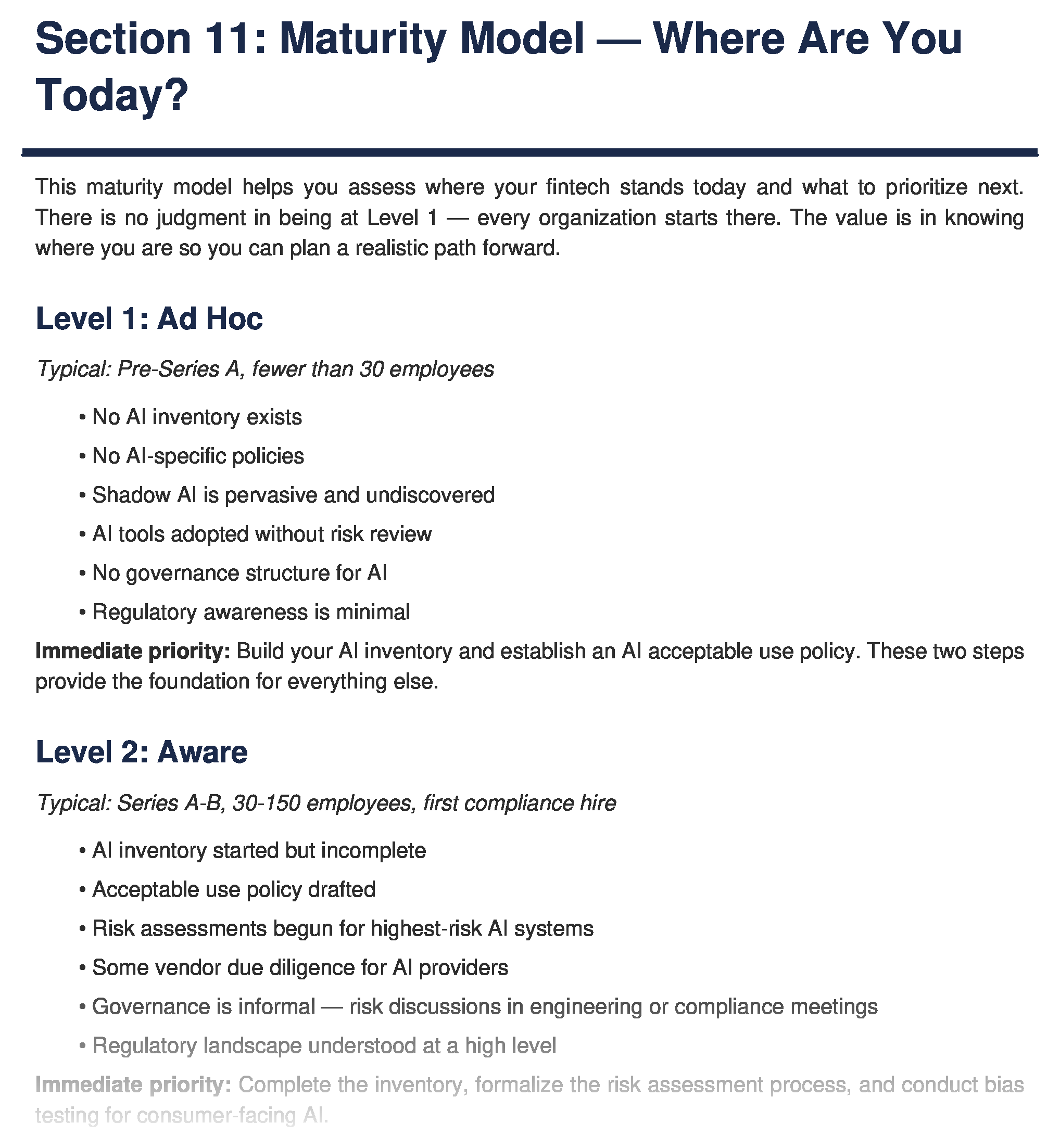
AI risk maturity model — 5 stages from ad-hoc to optimized, with specific criteria for each

AI risk maturity model — 5 stages from ad-hoc to optimized, with specific criteria for each

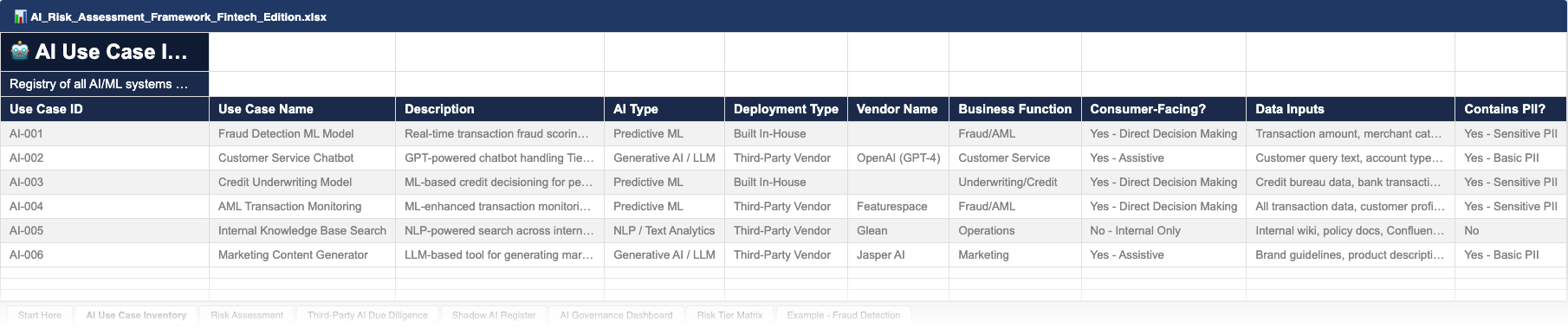
Excel template — AI Use Case Inventory with risk tiering, model details, and assessment status

Excel template — AI Use Case Inventory with risk tiering, model details, and assessment status

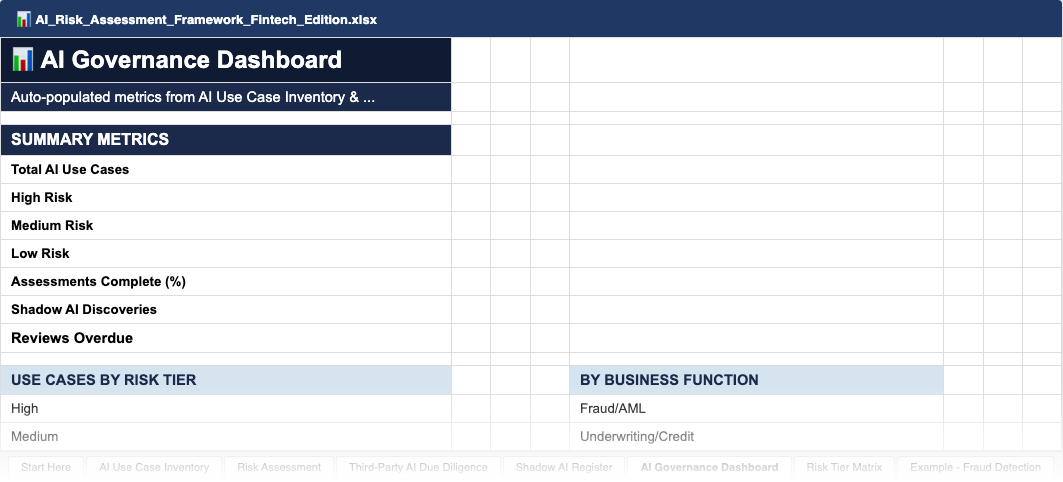
AI Governance Dashboard — risk scores, open issues, and compliance status at a glance

AI Governance Dashboard — risk scores, open issues, and compliance status at a glance

What's Included

  • AI Use Case Inventory tab with auto-tiering formula (consumer impact + decisioning role + PII + regulatory touchpoint)
  • 44-question pre-deployment risk assessment scorecard across 11 risk domains
  • 31-question third-party AI vendor due diligence questionnaire
  • 8 pre-filled worked examples: Fraud Detection, Customer Chatbot, Credit Underwriting, AML Monitoring, Marketing GenAI, Shadow AI ChatGPT, BaaS KYC AI, Crypto Sanctions AI
  • Filled vendor questionnaire (OpenAI) — what acceptable answers look like
  • Bank Partner Response Library PDF — 8 pre-written responses to the most common bank partner AI governance questions
  • AI Governance Dashboard tab and quarterly Board Report tab
  • Shadow AI Register tab and discovery methodology

What this saves you

The efficiency is in the research and template construction a practitioner would otherwise do from scratch. A realistic breakdown:

Task a practitioner would do from scratch Hours
Read current regs (NIST AI RMF 1.1, 2026 OCC model risk guidance, Colorado AI Act, state AI laws, FS AI RMF, EU AI Act) 40–60
Build AI model inventory template with risk tiering logic 20–30
Draft AI vendor due diligence questionnaire 15–25
Build pre-deployment checklist + bias evaluation rubric 20–30
Total practitioner time 95–145 hours

At typical loaded compliance rates ($100–150/hr), that's $9,500–21,750 of internal time — or weeks of focus you don't have. The $49 template replaces the research and construction phase, so your team can spend their time on the work only they can do: applying it to your business.

How this compares to your alternatives

Most risk and compliance teams considering an AI governance program weigh three paths. Here's what each one actually costs in time and money.

Compared on DIY from scratch Big-4 / boutique consultant This template
Time to a first defensible draft 95–145 hours 6–12 weeks Same day to populate
Cost $9.5K–$21K in internal time $50K–$200K engagement fee $59
2026 regulatory mapping You read every primary source Depends on engagement scope Built in: NIST AI RMF 1.1, 2026 OCC model risk guidance, Colorado AI Act, CFPB Reg B, EU AI Act
Bank partner AI questionnaire prep Build from a blank page Custom deliverable, multi-week lead time 8 pre-written responses to the most common bank partner AI questions
Worked examples for calibration None — your team is the calibration Limited to your engagement 8 pre-filled (fraud, chatbot, credit, AML, GenAI, shadow AI, BaaS KYC, crypto sanctions)

All three paths get you to the same place. The template is the only one that doesn't burn weeks of internal time or six figures of engagement fees on the way there.

How to roll this out in 30 days

Buying the template is 10% of the work. Getting it populated, reviewed, and in front of leadership is the other 90%. Here's the 30-day rollout — which workshops to run, who to invite, what to tell teams, and what you walk away with.

  1. Week 1

    Stand up the inventory

    Run an AI Inventory Discovery workshop with engineering, product, ML, ops, and support leads. Populate Tab 1 with every AI/ML tool in production, development, and pilot. Frame it to teams as visibility, not restriction — bank partners and regulators need it documented.

  2. Week 2

    Risk-tier every use case

    Template auto-tiers each use case (High/Medium/Low) based on consumer impact, decisioning role, PII, and regulatory touchpoint. Run a 45-minute Risk Tiering Review with risk, compliance, legal, and High-tier use case owners.

  3. Week 3

    Assess High-tier + vendor AI

    Complete the Risk Assessment Scorecard (44 questions, 11 domains) for every High-tier use case. Send the Vendor AI Due Diligence Questionnaire to every third-party AI vendor with a 10-business-day return window.

  4. Week 4

    Shadow AI + board-ready reporting

    Run an org-wide amnesty survey to surface Shadow AI (the ChatGPT and Copilot usage nobody told you about). Populate the AI Governance Dashboard. Present to risk committee or leadership: High-tier list, open red flags, 90-day remediation plan.

📄 Full playbook in the PDF guide: The complete rollout plan — including who to invite to each workshop, the messaging to give teams, and what each meeting's deliverable looks like — is in the PDF guide you get with the template.

Mapped to 2026 regulations — with traceability

Every section cites the specific regulatory source. When your examiner or bank partner asks "where did this come from?" you have a citation.

  • NIST AI RMF 1.1 (GOVERN, MAP, MEASURE, MANAGE functions)
  • 2026 OCC Model Risk Management Guidance (replacing SR 11-7)
  • FS AI RMF (U.S. Treasury, February 2026 — 230 control objectives)
  • Colorado AI Act (effective June 2026)
  • CFPB Reg B / ECOA disparate impact final rule (effective July 21, 2026)
  • EU AI Act high-risk provisions (effective August 2, 2026)
  • NYDFS AI cybersecurity guidance
  • ISO 42001:2023 (AI management systems)

Used by compliance and risk teams at sponsor banks, community banks, GSEs, and global fintechs to operationalize their AI governance programs.

Last updated: May 1, 2026

🛡️

30-Day Money-Back Guarantee

If this template doesn't meet your expectations, email us within 30 days for a full refund. No questions asked.

Frequently Asked Questions

What does the AI model inventory template track?

Each model entry captures: model name and type, use case, risk tier (High/Medium/Low), development source (in-house vs. vendor), regulatory applicability (NIST AI RMF 1.1, 2026 OCC model risk guidance, state AI laws, CFPB ECOA), assessment status, owner, and last review date. You can populate your first inventory in an afternoon.

What's in the pre-deployment checklist?

The pre-deployment checklist covers 11 domains before any AI model goes live: data quality validation, bias and fairness testing, explainability requirements, model documentation, compliance review, legal sign-off, technical controls, monitoring setup, fallback procedures, vendor due diligence (if applicable), and final approval routing.

How does the third-party AI vendor questionnaire work?

It's a structured questionnaire you send to any AI vendor before onboarding, covering: training data sourcing and bias controls, model explainability, drift monitoring, incident notification procedures, regulatory compliance certifications, and data handling under GLBA and other applicable laws. Banks are increasingly requiring this before approving AI tools.

How does this handle the 2026 regulatory shift — SR 11-7 rescission, new state AI laws, and CFPB updates?

The framework is updated for 2026: it maps to the OCC's 2026 model risk management guidance (which replaced SR 11-7) while preserving the validation, independent review, and ongoing monitoring principles SR 11-7 established. It also covers NIST AI RMF 1.1 functions (GOVERN, MAP, MEASURE, MANAGE), Colorado AI Act, FS AI RMF, CFPB ECOA disparate impact provisions for AI-driven lending and adverse action, and EU AI Act high-risk requirements (relevant for any US fintech with EU customers).

What's included in the bias and fairness evaluation guide?

The guide covers demographic parity, equal opportunity, and disparate impact testing methodologies. It includes a scoring rubric for rating bias risk, a list of fairness metrics with Excel formulas, and escalation criteria for models that fail initial bias screening — designed for teams without dedicated data science resources.

Can I use this if I only use AI tools from third-party vendors, not custom models?

Yes — a large portion of the kit is designed specifically for vendor AI, including the third-party questionnaire, vendor risk tiering criteria, and TPRM integration guidance. The model inventory covers both in-house models and vendor-supplied AI tools.

Not ready to buy?

Try our free Risk Register first — no payment required.

Download Free Risk Register →

Related Products

📄 Template
$49

KRI Library (132 Key Risk Indicators)

132 KRIs with thresholds, data sources, and escalation triggers pre-built for financial services.

📄 Template
$49

Issues Management Tracker & Template

End-to-end issues tracking and remediation management for risk and compliance teams.

📄 Template
$69

Third-Party Risk Management (TPRM) Kit

Complete vendor risk management lifecycle from initial due diligence to ongoing oversight.

Ready to Get Started?

Get the AI Risk Assessment Template & Guide and start building a defensible risk program today.

Buy $59 →
🔒 Secure Checkout ⚡ Instant Download 📝 Fully Editable ✅ 30-Day Money-Back Guarantee