📄 Template ✨ Updated May 2026

Business Continuity & Disaster Recovery (BCP/DR) Kit

BCP and DR templates with BIA, recovery procedures, and a standalone tabletop exercise kit.

$79
Buy Now →
🔒 Secure Checkout ⚡ Instant Download 📝 Fully Editable ✅ 30-Day Money-Back Guarantee

Used by compliance teams at banks, fintechs, and asset managers

When BCP failure makes the news

These aren't theoretical scenarios. They happened to real companies in financial services within the last 36 months. They were expensive, public, and largely preventable with a tested BCP program — and they're exactly the kind of incidents your bank partner, examiner, and board will reference in your next review.

July 2024

CrowdStrike Falcon Outage

A faulty CrowdStrike Falcon Sensor update crashed ~8.5 million Windows devices on July 19, 2024 — airlines, hospitals, banks, retailers, government services. Recovery required physical access to each device to apply the manual fix.

Impact: Parametrix estimated ~$5.4B in losses across the top 500 US companies. Delta reported $500M in disruption costs and sued CrowdStrike in October 2024; CrowdStrike countersued. Worldwide damage in the tens of billions.

Lesson: Security tools became a single point of failure. Vendor concentration risk in endpoint protection wasn't on most BCPs. Manual recovery procedures and offline operating capability suddenly mattered.
April 2024

Synapse Financial Technologies Bankruptcy

Synapse — middleware connecting fintechs like Yotta, Juno, and Copper to sponsor banks (including Evolve) — filed Chapter 11 on April 22, 2024. The trustee discovered the ledger couldn't reconcile which customer was owed which dollars across partner banks.

Impact: 200,000+ customer accounts and ~$160M in deposits locked starting May 11, 2024. Trustee reported a $65M–$95M shortfall between customer claims and recoverable funds. Triggered FDIC custodial deposit rulemaking and CFPB enforcement.

Lesson: Counterparty failure is a BCP event, not just a credit event. Your continuity plan needs to answer: what happens when our middleware partner files Chapter 11 and freezes the ledger?

February 2024

Change Healthcare Ransomware

Ransomware at a UnitedHealth subsidiary that processes healthcare claims cascaded across the industry. Pharmacies couldn't fill prescriptions for weeks. Attack detected February 21, 2024, attributed to the ALPHV/BlackCat ransomware gang.

Impact: UnitedHealth reported ~$2.88B in response costs by Q2 2025 and paid ~$22M (350 BTC) in ransom. Affected 131M+ patients and nearly 67,000 pharmacies. Recovery played out over many months with services restored in stages.

Lesson: Ransomware doesn't have to hit you directly to take you down. Your BCP needs alternative-vendor activation playbooks pre-built — not improvised mid-incident when your critical vendor is offline.

March 2023

SVB Bank Run + First Republic Cascade

A Twitter-fueled deposit run hit SVB with $42B in withdrawal requests on March 9, 2023 — 25% of total deposits in a single day. California DFPI took possession on March 10; FDIC became receiver. First Republic was seized seven weeks later.

Impact: Both seized — second- and third-largest US bank failures in history. Depositor confidence shaken across regional banks. Fed launched the Bank Term Funding Program (BTFP) as emergency liquidity. Massive stress on bank IT, customer service, and treasury teams.

Lesson: Liquidity crises are now operational and reputational at the same time. Your BCP must include deposit run scenarios, social media monitoring playbooks, customer communications strategies, and contingency funding plan activation.

If you're reading this trying to make sure your company doesn't end up on this list — you're in the right place. Here's what you'd recognize:

If any of these sound familiar, you're in the right place

Your bank partner just asked for a Business Continuity Plan with FFIEC-aligned documentation.

A real BCP isn't just a 10-page document — it's a BIA with RTO/RPO targets, dependency mapping, recovery procedures, tested tabletops, and an action item tracker. This kit gives you all of it, ready to populate.

Your last tabletop exercise was the day-of-incident — the actual incident.

Most fintechs discover their BCP gaps when something breaks. The Tabletop Exercise Kit + Case Study Walkthroughs let you find the gaps in 90 minutes of conference room time, not 8 hours of customer-facing chaos.

You're preparing for an OCC, FDIC, or state exam and BCM is on the checklist.

Examiners review BCP against the FFIEC BCM Handbook. The kit is built explicitly against those requirements — Section III.B (Risk Assessment), Section IV.A (BIA), Section VII (Testing), and the post-2024 ransomware emphasis in Section VII.G.

📅

Updated for the post-2024 BCM regulatory shift

The 2023 FFIEC BCM Handbook update emphasized testing rigor and ransomware-specific scenarios. The OCC has signaled heightened standards for community banks at $500M+ assets. NYDFS Part 500 expanded incident notification requirements (36-hour rule). Bank partners are requiring detailed BCP documentation from fintech partners as a precondition for renewal. This kit reflects all of it — including 4 worked BIAs by business type and 4 played-out case study walkthroughs (ransomware, AWS regional outage, critical vendor failure, key-person + pandemic).

About This Template

A complete business continuity and disaster recovery toolkit aligned with the FFIEC BCM Handbook. Includes Business Impact Analysis template, BCP/DR plan templates, recovery procedures, dependency mapping, emergency contacts, test & exercise log, action item tracking, BCP Dashboard and quarterly Board Report tabs, plus 4 worked BIA examples (Fintech Lender, Community Bank, BaaS Provider, Crypto Custodian), a 23-page Tabletop Exercise Kit, and a 30-page Case Study Walkthroughs PDF showing hour-by-hour played-out responses to real-world disruption scenarios.

Most BCP plans sit in a drawer until something goes wrong — and then nobody can find them. This kit is designed to be operational, not theoretical. The BIA template walks your business owners through identifying critical processes, dependencies, and recovery priorities. The Tabletop Exercise Kit is a 90-minute facilitator-ready exercise. The Case Study Walkthroughs show what a well-prepared response actually looks like — with real timelines, decisions, communications, and lessons learned — so your team has a benchmark for what good looks like.

🎉 First-Time Buyer?

Enter your email to get 20% off this purchase.

Who Is This For?

  • Your bank partner has asked for your Business Continuity Plan and you don't have FFIEC-aligned documentation
  • You need to run an annual tabletop exercise to meet testing requirements but don't have a facilitator guide or scenarios
  • Your BCP plan exists on paper but has never been tested and you're not confident it would actually work
  • You need a BIA to identify your critical processes and set RTO/RPO targets before your next exam
  • You need pre-built worked examples calibrated for your business type (fintech lender, community bank, BaaS, crypto)

Where this fits in your BCP/DR program

  • If you have a documented BCP — this gives you the worked examples to benchmark against, the tabletop scenarios to test it, and the case studies to brief leadership.
  • If you have nothing yet — this is your week-one program. Pick the persona closest to your business (Fintech Lender, Community Bank, BaaS, Crypto), adapt the worked BIA, and you have a defensible starting point.
  • If you're preparing for an exam — bring the BIA, the dependency map, the test log, the case study walkthroughs, and the action item tracker. That's what examiners want to see.
  • If you have a BCP but haven't tested it recently — start with the Tabletop Exercise Kit. 90 minutes, 4 scenarios, no prep required.

What this is not

  • Not a replacement for a Crisis Management Officer or BCP Coordinator role at scale — this is the toolkit they use, not a substitute for the role.
  • Not a software platform — these are Excel + PDF templates, not a SaaS BCM tool.
  • Not a BCP-as-a-service engagement — no consultant will run your BIA workshops for you.
  • Not theoretical — these are operational templates with worked examples calibrated to your business type.

Preview

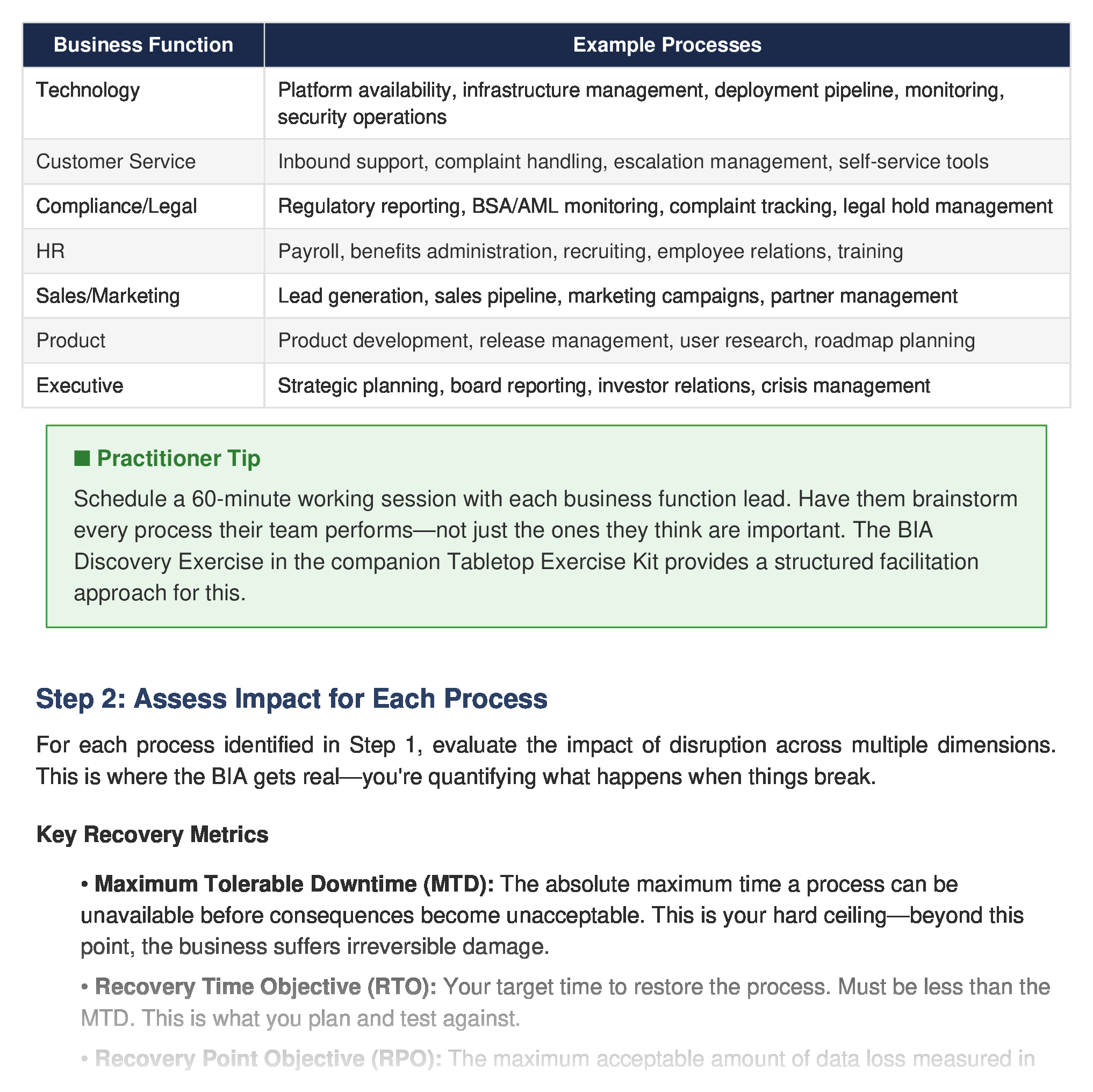
Business Impact Analysis framework — how to quantify RTO, RPO, and recovery priorities by business function

Business Impact Analysis framework — how to quantify RTO, RPO, and recovery priorities by business function

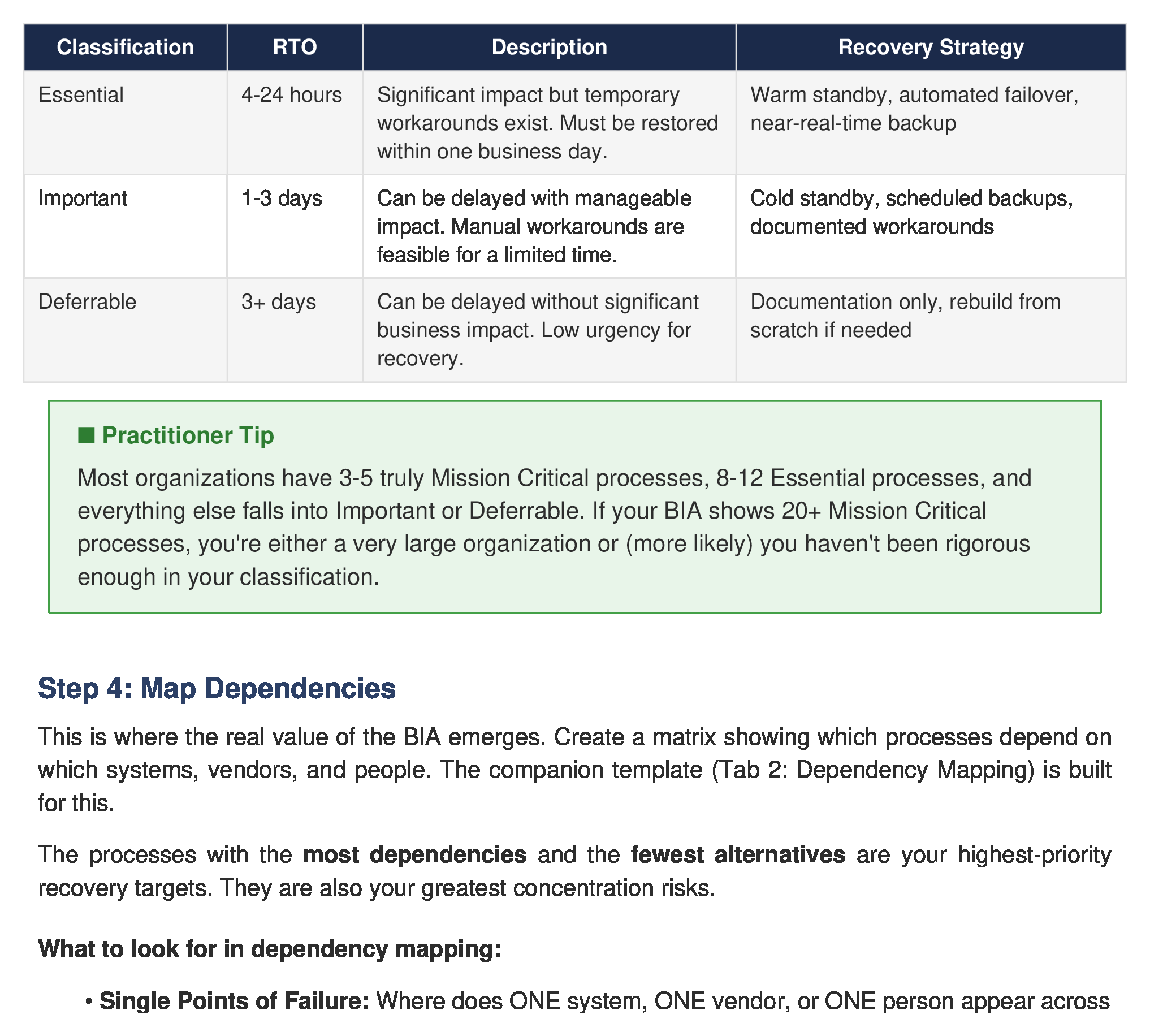
RTO classification tiers — Essential (4-24hrs), Important (24-72hrs), Deferred (72+ hrs) with recovery strategies

RTO classification tiers — Essential (4-24hrs), Important (24-72hrs), Deferred (72+ hrs) with recovery strategies

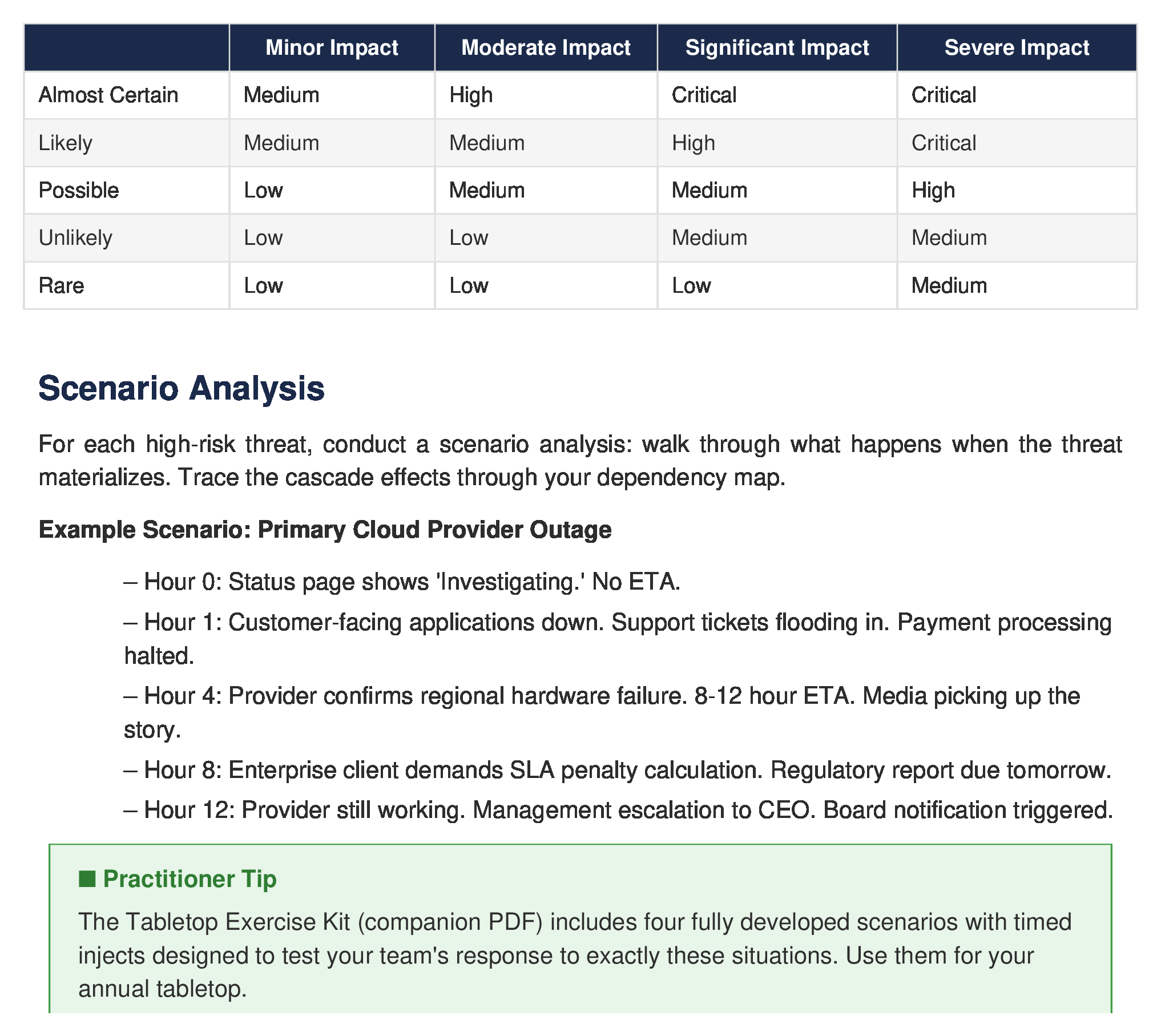
BCP risk assessment matrix — Impact × Likelihood with inherent vs. residual risk view

BCP risk assessment matrix — Impact × Likelihood with inherent vs. residual risk view

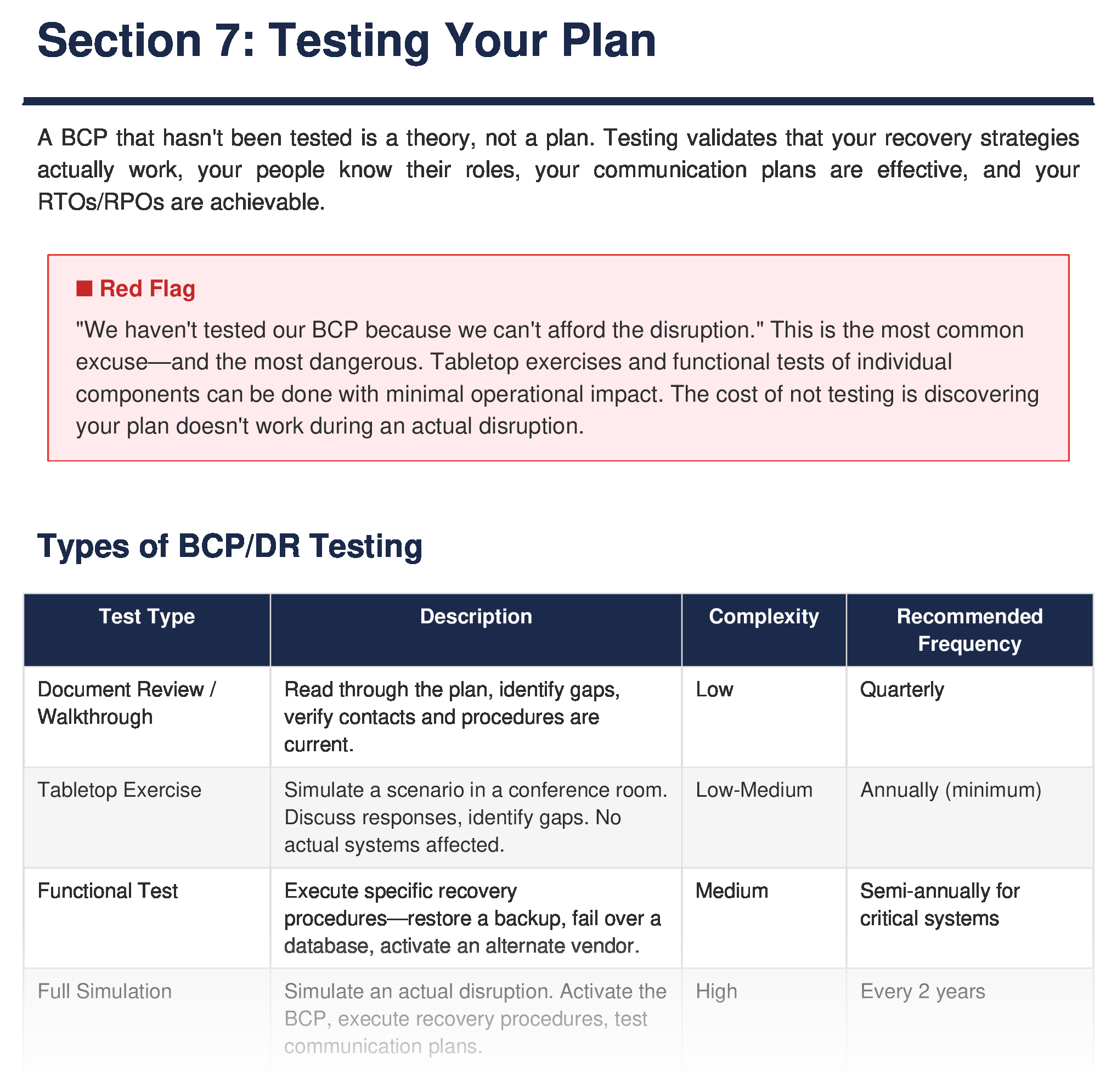
BCP testing framework — types of tests from tabletop to full simulation, with annual cadence recommendations

BCP testing framework — types of tests from tabletop to full simulation, with annual cadence recommendations

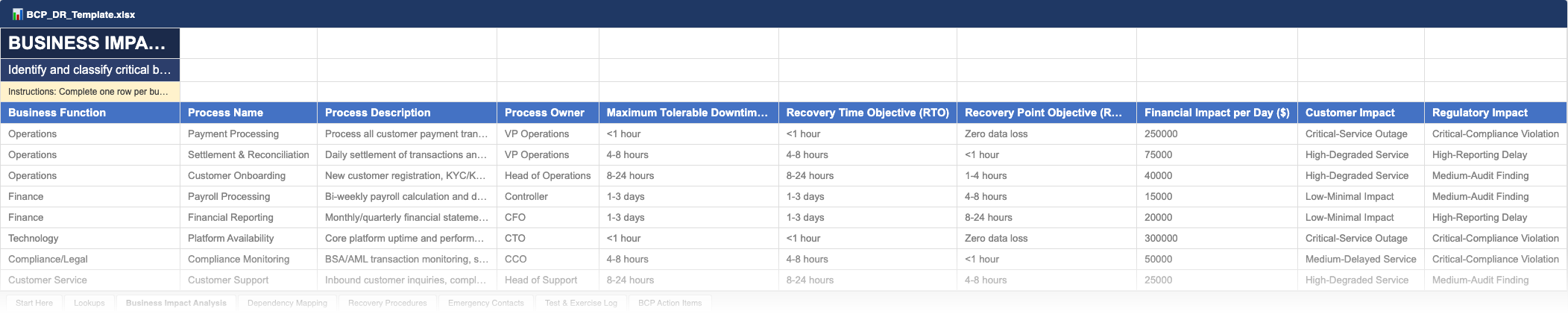
Excel template — Business Impact Analysis with RTO/RPO targets, dependency mapping, and criticality scores

Excel template — Business Impact Analysis with RTO/RPO targets, dependency mapping, and criticality scores

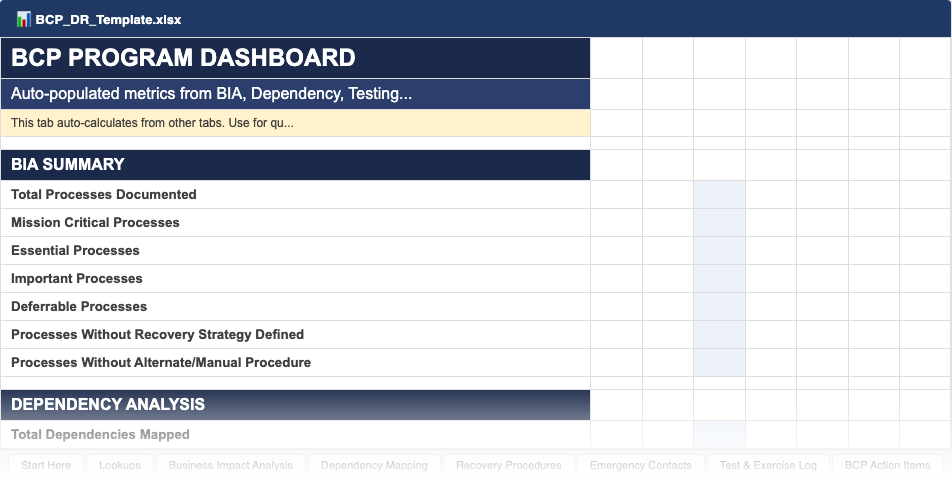
BCP Dashboard — recovery readiness scores, test results, and action item tracking

BCP Dashboard — recovery readiness scores, test results, and action item tracking

What's Included

  • Business Impact Analysis (BIA) template with auto-classification of critical processes
  • BCP, DR, dependency mapping, and recovery procedures templates
  • 4 worked BIA examples: Fintech Lender, Community Bank, BaaS Provider, Crypto Custodian
  • Tabletop Exercise Kit (23 pages) — facilitator guide + 5 scenario cards + findings template
  • Case Study Walkthroughs (30 pages) — hour-by-hour played-out responses to ransomware, AWS outage, vendor failure, key-person + pandemic
  • Crisis communication templates and emergency contacts register
  • Test & Exercise Log and BCP Action Items tracker
  • BCP Dashboard tab and quarterly Board Report tab with auto-calculated readiness metrics

What this saves you

Building a defensible BCP/DR program from scratch typically takes:

Task a practitioner would do from scratch Hours
Read FFIEC BCM Handbook + relevant OCC/Fed guidance 20–30
Build BIA template with auto-classification logic 15–25
Build dependency mapping and recovery procedures structure 15–25
Draft tabletop exercise scenarios and facilitator guide 20–30
Develop case-by-case response playbooks for common incidents 25–40
Total practitioner time 95–150 hours

At typical loaded compliance/risk rates ($100–150/hr), that's $9,500–22,500 of internal time. The $79 kit replaces the research and template construction phase, so your team can spend their time populating it for your business — not building it from scratch.

How to roll this out in 30 days

BCP programs fail when they're built in a vacuum by compliance and never owned by the business. The 30-day rollout below puts business owners at the center.

  1. Week 1

    Run the BIA Discovery workshop

    Use the Tabletop Exercise Kit's BIA Discovery Exercise (5 rounds, 90 minutes) with one leader from each business function. Output: a populated BIA with critical processes, owners, dependencies, and RTOs.

  2. Week 2

    Populate dependency mapping and recovery procedures

    Each function lead maps their process dependencies (systems, vendors, people, upstream/downstream processes) and drafts recovery procedures. Use the worked example matching your business type as a starting point.

  3. Week 3

    Run a tabletop exercise

    Pick the scenario most relevant to your risk profile (ransomware, vendor outage, key-person, pandemic). Run the 90-minute exercise. Use the Case Study Walkthrough as the calibration benchmark for what good looks like.

  4. Week 4

    Document and brief leadership

    Capture findings in the action item tracker, update the test log, populate the dashboard, brief the risk committee. Outcome: a defensible BCP your examiner, bank partner, or board can review with confidence.

📄 Full playbook in the PDF guide: Detailed workshop agendas, participant lists, and messaging are in the Tabletop Exercise Kit and Case Study Walkthroughs PDFs you get with the template.

Aligned with FFIEC BCM Handbook + 2024-2026 BCM regulatory landscape

Every section of the kit cites its regulatory source so examiners and bank partners get traceable answers:

  • FFIEC Business Continuity Management Handbook (current version)
  • FFIEC IT Examination Handbook
  • OCC heightened standards for community banks ($500M+ assets)
  • NYDFS Part 500 (cybersecurity + 36-hour incident notification)
  • Federal Reserve SR 14-1 (funding contingency planning)
  • OCC Bulletin 2023-17 (interagency third-party risk management)
  • CFPB UDAAP guidance on outage messaging
  • ISO 22301 (Business Continuity Management Systems)

Used by compliance and operations teams at fintech lenders, community banks, BaaS providers, and crypto custodians to operationalize their BCP/DR programs.

Last updated: May 1, 2026

🛡️

30-Day Money-Back Guarantee

If this template doesn't meet your expectations, email us within 30 days for a full refund. No questions asked.

Frequently Asked Questions

How does the Business Impact Analysis template work?

The BIA template walks you through identifying critical business processes, mapping their dependencies (systems, vendors, staff, data), and assigning RTO (Recovery Time Objective) and RPO (Recovery Point Objective) targets. The output is a prioritized list of what to recover first in any disruption scenario — the foundation your BCP and DR plan are built on.

What are the 3 RTO classification tiers and what does each mean?

Essential (RTO 4–24 hours): processes where disruption within hours causes significant financial or customer harm — payment processing, fraud monitoring, core banking integrations. Important (RTO 24–72 hours): significant but not critical — reporting, compliance functions, secondary customer channels. Deferred (RTO 72+ hours): processes that can wait — analytics, archival functions, back-office administrative tasks.

What's in the standalone Tabletop Exercise Kit PDF?

The 23-page PDF includes: a facilitator guide with step-by-step instructions for running a 90-minute exercise, 5 scenario cards (each is a scenario brief with inject questions — covering ransomware, extended vendor outage, key person departure, natural disaster, and payment rail disruption), a participant worksheet, and a findings capture template with post-exercise action items log. No additional prep required.

Does this meet FFIEC Business Continuity Management guidance?

Yes. The kit is specifically designed against FFIEC Business Continuity Management (BCM) booklet requirements, including: BIA coverage, plan documentation, testing and exercise requirements, board and senior management oversight, and third-party dependency management. These are the requirements that come up in bank partner due diligence and regulatory exams.

Can I use just the Tabletop Exercise Kit without the full BCP?

Yes — the tabletop exercise kit is a standalone PDF designed to be used independently. If you need to meet an annual testing requirement and already have a BCP, you can run the tabletop exercise without using any other part of the kit. Many teams use it for their annual FFIEC-required BCP test.

How does the crisis communication template work?

The crisis communication template includes pre-drafted notification templates for 4 audiences: customers (service disruption notice), bank partners (incident notification with RTO estimates), employees (internal emergency communication), and regulators (formal notification). Each template has fill-in-the-blank fields for the specific incident type, impact, and estimated resolution timeline.

Not ready to buy?

Try our free Risk Register first — no payment required.

Download Free Risk Register →

Related Products

📄 Template
$69

Incident Response & Breach Notification Kit

Step-by-step incident response playbooks and breach notification templates for all 50 states.

📄 Template
$79

SOC 2 Compliance Checklist

151 controls mapped to AICPA Trust Services Criteria with evidence collection guidance.

📄 Template
$69

Data Privacy Compliance Kit

Multi-state privacy compliance templates covering 19 state laws plus GLBA and CCPA.

Ready to Get Started?

Get the Business Continuity & Disaster Recovery (BCP/DR) Kit and start building a defensible risk program today.

Buy $79 →
🔒 Secure Checkout ⚡ Instant Download 📝 Fully Editable ✅ 30-Day Money-Back Guarantee