Operational Loss Event Tracking Template for Fintechs
Operational loss and near-miss tracking for fintechs — with automatic escalation tiers, bank-partner notice flags and a dashboard that calculates itself.
Price
$59
One-time. No subscription. Use forever.
Delivered immediately after checkout — your template and guide links are emailed to you with your receipt.
Built for risk and compliance teams at financial-services organizations
◆ Quick buying summary
What you get and when you can use it
- Good fit if
- Your bank partner or examiner has asked whether you track operational losses and near-misses
- Format
- Editable Excel workbook (9 tabs) plus a 14-page PDF implementation guide. Instant download after checkout.
- Need the methodology first?
- Read the Operational Loss Event Tracking Template Guide.
- Time to value
- Start reviewing, editing, and assigning owners the same day; customize to your organization before sharing outputs externally.
- After purchase
- After payment, download every file immediately from the confirmation page. RiskTemplates also emails a secure access link, and Stripe sends the payment receipt separately. No account required.
◆ What's included
- ◆ Loss event log for losses and near misses across the 7 Basel event types, with typologies (account takeover, APP scams, check fraud, synthetic identity and more)
- ◆ Automatic net loss, escalation tier, internal timeline and bank-partner notice flag on every event
- ◆ Dashboard by category, business line, tier and quarter, with top 10 losses, largest near misses and charts
- ◆ Escalation Alerts: open Tier 3–4 events and outstanding bank notices, with who to escalate to
- ◆ First 10 Events worksheet to seed the log from the last 12 months
- ◆ Quick RCA on every event plus a deep-dive root cause template with a completed example
- ◆ Category guide with the credit-vs-operational boundary and mapping to RCSA and KRI Library categories
- ◆ Notification reference (bank incident rule, FTC Safeguards Rule, SARs, New York DFS, SEC) and a 14-page guide
Use rights: customize for internal business use and use outputs with your auditors, customers, bank partners, and regulators. Do not resell or redistribute the template files.
◆ Preview
See what the template covers.
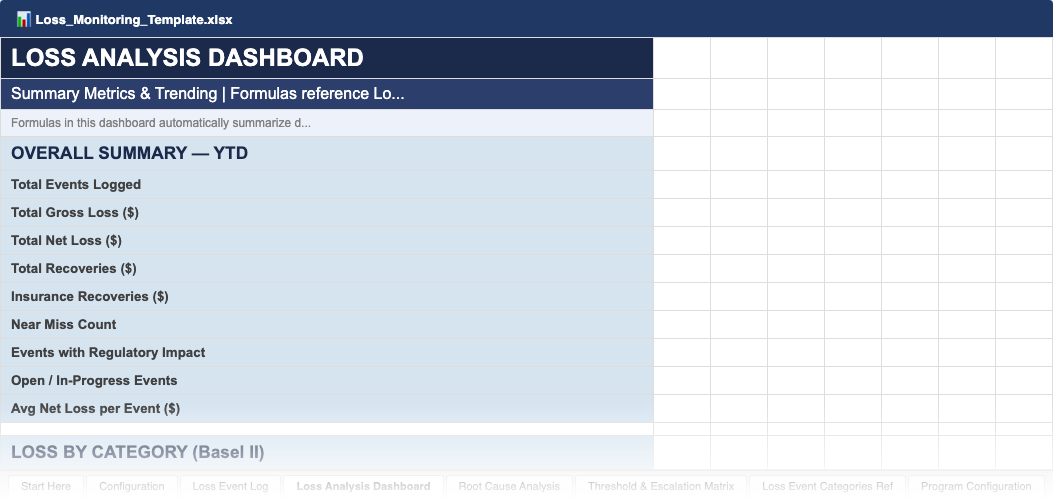
Loss Analysis Dashboard — totals, alerts and loss by event category, all calculated from the log
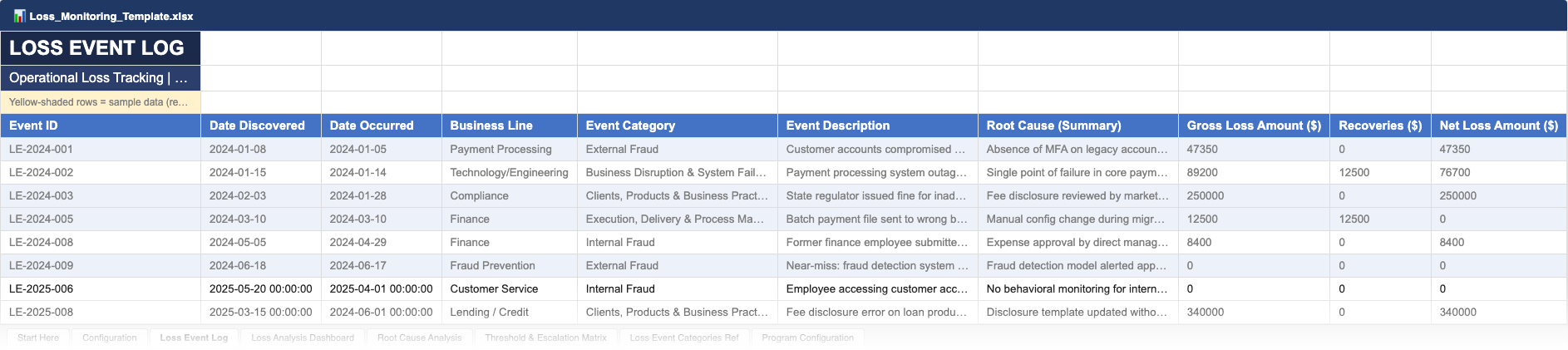
Loss Event Log — net loss, escalation tier, internal timeline and bank-partner notice calculated on every event

Escalation Alerts — open Tier 3–4 events and bank notices outstanding
◆ Template guide
Operational Loss Event Tracking Template Guide
How to build an operational loss event log: Basel loss categories, gross vs. net loss, near-miss tracking, root cause analysis, escalation tiers, and the loss data evidence bank partners ask for.
◆ FAQ
Frequently asked questions.
What are the 7 event categories?
The seven Basel operational loss event types: External Fraud; Internal Fraud; Clients, Products & Business Practices; Business Disruption & System Failures; Execution, Delivery & Process Management; Employment Practices & Workplace Safety; and Damage to Physical Assets. The Category Guide explains each in plain English with fintech examples, how to tell them apart, and what counts as a loss.
How are near misses tracked?
Near misses are logged in the same log with a Near Miss flag and an estimated potential loss. They get their own count on the dashboard, a list of the largest near misses, and their own escalation tier, so a control that caught something just in time is recorded and reviewed.
How does escalation work?
Each event's tier is calculated from its gross loss and special triggers — customers affected, regulatory impact, data breach and outage hours — using thresholds you set. The log shows the internal timeline for the tier and flags when bank-partner notice is required — for example, a computer-security incident that has materially disrupted or degraded, or is reasonably likely to, the services you provide the bank for four hours or more (12 CFR 53.4), which you can flag early by entering expected outage hours. A near miss that also involves a data breach or regulatory impact still escalates. The Escalation Alerts tab lists every open Tier 3–4 event and any bank notice not yet sent, with who to escalate to.
What is the First 10 Events worksheet?
Ten prompts — your largest fraud loss, a misrouted payment, your longest outage, refunds from a disclosure error, vendor failures, fines, employee misconduct, scam reimbursements, a near miss and a reconciliation break — each with where to look and who to ask, so you can seed the log with the last 12 months instead of starting from a blank dashboard.
Do regulators require fintechs to track operational losses?
No US rule sets a loss-data standard for non-banks, and fintechs don't hold operational risk capital. But sponsor banks oversee their fintech partners' risks, their examiners look at that oversight, and many program agreements require loss and incident reporting. A consistent loss log answers those questions and uses the same event types banks use.
How does this connect to the RCSA and KRI Library?
The Category Guide maps each event category to the RCSA's 21 risk categories, which the KRI Library also uses (plus two KRI-only categories). The guide explains what should happen when a loss occurs: re-rate the related RCSA control, check whether a KRI should have warned you, and open an issue for each corrective action.
Can I share completed outputs externally?
Yes. You can use completed outputs with auditors, customers, bank partners, regulators, and internal stakeholders. Customize the template for internal business use — just don't resell or redistribute the source template files.
How do I receive the files?
Checkout is handled through Stripe. After payment, download every file immediately from the confirmation page. RiskTemplates also emails a secure access link, and Stripe sends the payment receipt separately. No account is required.
What if it's not a fit?
Email within 30 days for a full refund, no questions asked. The guarantee is meant to remove purchase risk while you evaluate whether the template fits your use case.
● First-time buyer offer
Get 20% off your first template.
Drop your email and we'll send the code.
◆ Not ready to buy?
Start with the free Risk Register.
141 pre-populated fintech risks across 21 categories. ISO 31000 structure.
Download free Risk Register →◆ Related templates
Pairs well with.
Enterprise Risk Management Framework (ERMF)
Complete ERM documentation: risk appetite, 3 Lines of Defense, committee charter, and board reporting.
RCSA (Risk & Control Self-Assessment)
141 fintech risks with mapped controls, a 97-question self-assessment, control testing plan, challenge log and a one-page Board Summary.
KRI Library (152 Key Risk Indicators)
152 KRIs — including 20 emerging-risk KRIs for AI-enabled fraud, scams and AI governance — with thresholds, owners and a calculating dashboard.
◆ Ready when you are
Get the Loss Monitoring & Event Tracking Kit.
Start building a defensible risk program today.