Skip to content
RiskTemplates · The Daily Brief Friday, August 7, 2026
Wire SEC’s New Financial Reporting and Accounting Unit: The ICFR Review to Start Now AUG 5
Template Updated May 2026

New Product Risk Assessment Template

Structured risk review process for new products, services, and business initiatives.

Price

$59

One-time. No subscription. Use forever.

Buy & download — $59 →
Secure checkout Emailed access Fully editable 30-day money-back

Delivered immediately after checkout — your template and guide links are emailed to you with your receipt.

Built for risk and compliance teams at financial-services organizations

◆ Quick buying summary

What you get and when you can use it

Good fit if
Your bank partner is asking for a formal risk assessment before approving a new product launch
Format
Editable Excel workbook plus companion PDF guide. Instant download after checkout.
Need the methodology first?
Read the New Product Risk Assessment Template Guide.
Time to value
Start reviewing, editing, and assigning owners the same day; customize to your organization before sharing outputs externally.
After purchase
After checkout, your templates and guides are available immediately and the download link is sent to your email with your Stripe receipt. No account required.

◆ What's included

  • New Product Risk Assessment questionnaire (12 risk categories: Compliance, Regulatory, Operational, Technology, Fraud, Third-Party, Credit, Liquidity, Data/Privacy, Reputational, Strategic, Model Risk)
  • Risk scoring matrix with inherent and residual ratings
  • Money/data flow mapping tab for operational dependency tracing
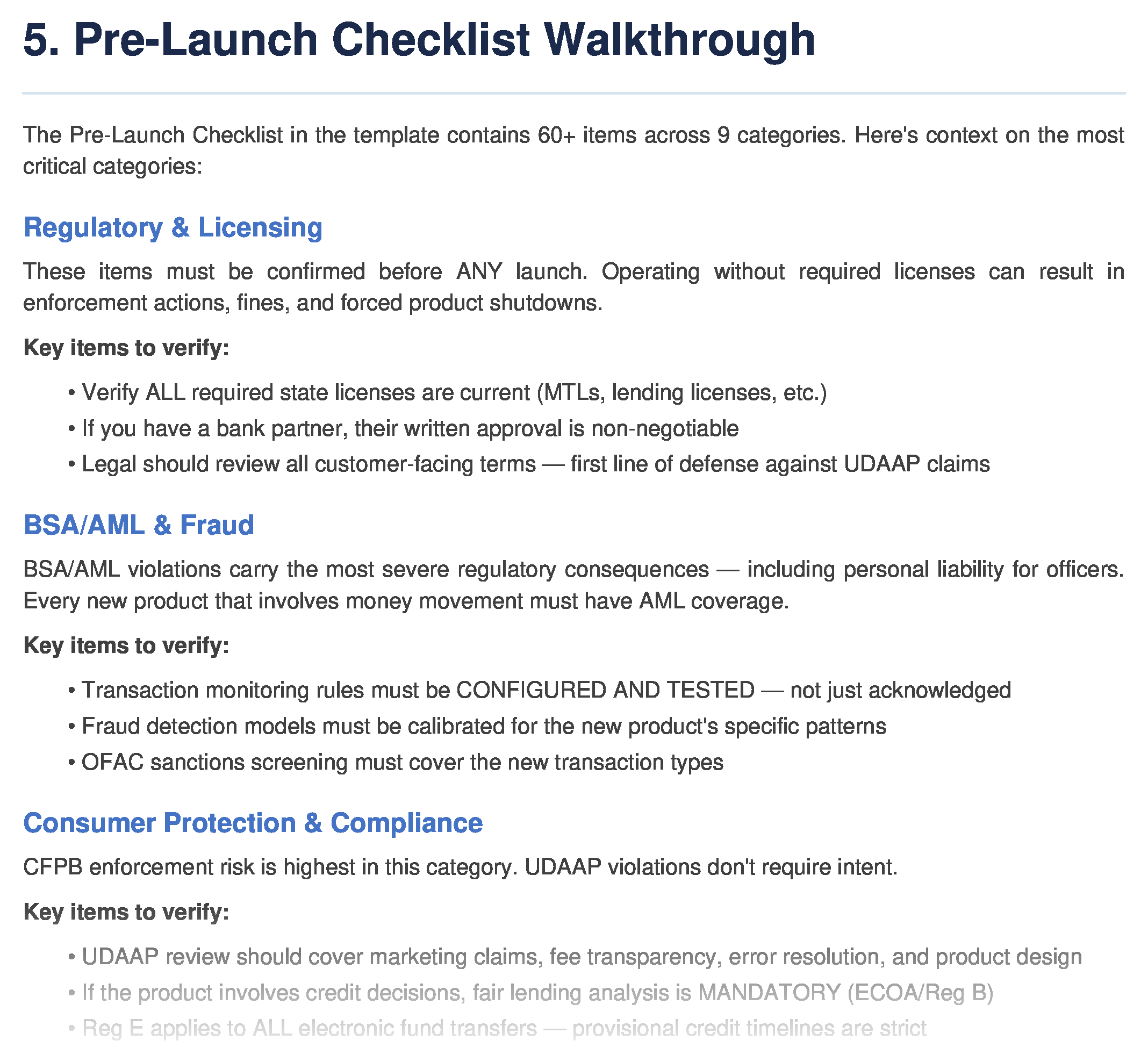
  • Pre-Launch Checklist — 58 items across 9 categories (Regulatory & Licensing, BSA/AML & Fraud, Consumer Protection & Compliance, Technology & Security, Data Privacy, Third-Party / Vendor Management, Operational Readiness, Financial & Risk Management, Governance & Documentation)
  • Risk Register that aggregates findings with sign-off rows for 1st/2nd line review and Risk Committee approval
  • 4 worked example assessments (BNPL, Embedded Finance, Instant Payments, Stablecoins)
  • Companion PDF Guide with decision tree triggers, regulatory expectations, and worked-example walkthroughs

Use rights: customize for internal business use and use outputs with your auditors, customers, bank partners, and regulators. Do not resell or redistribute the template files.

◆ Preview

See what the template covers.

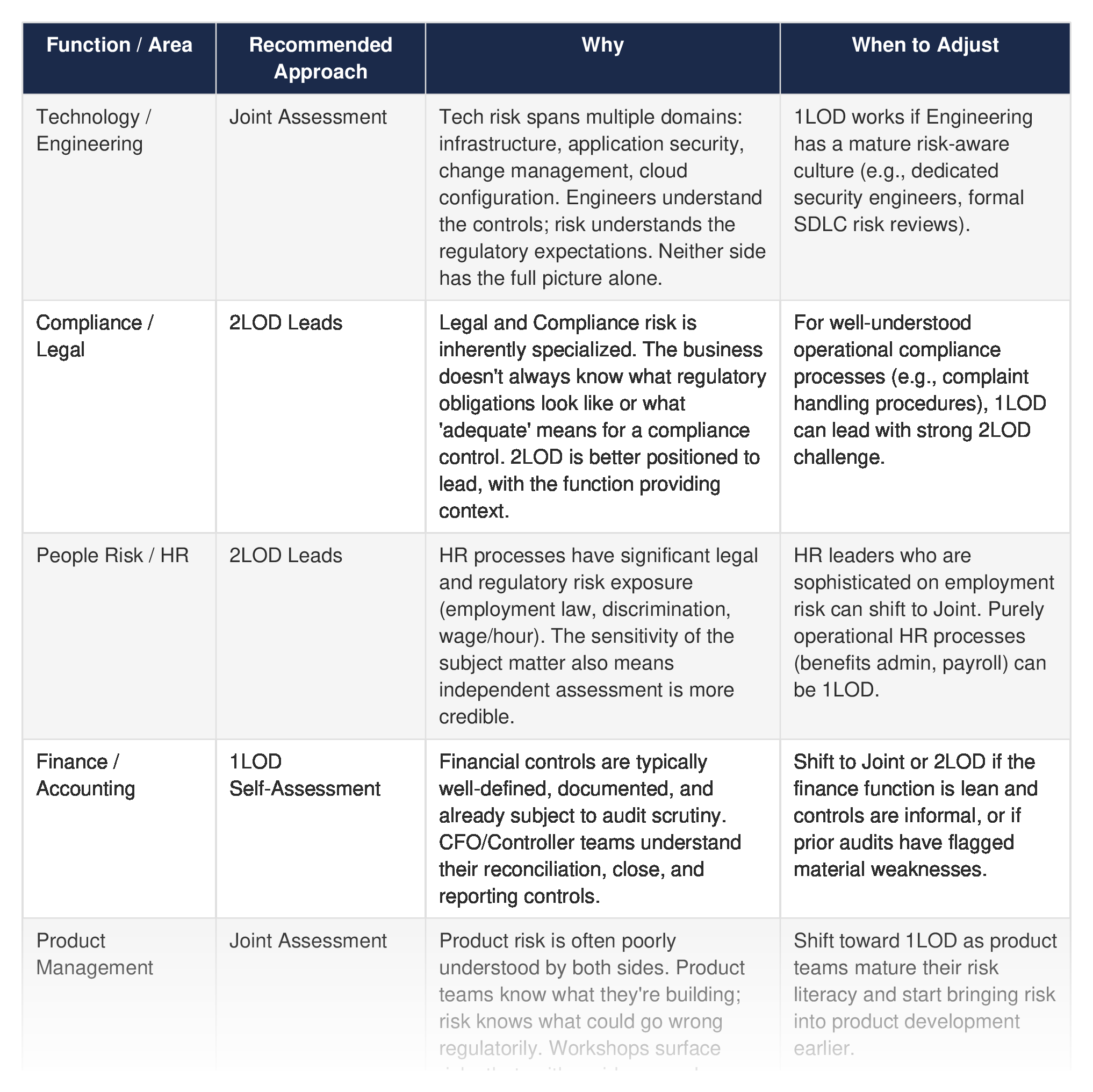
New product risk assessment triggers — 5 decision questions that determine when a full assessment is required

New product risk assessment triggers — 5 decision questions that determine when a full assessment is required

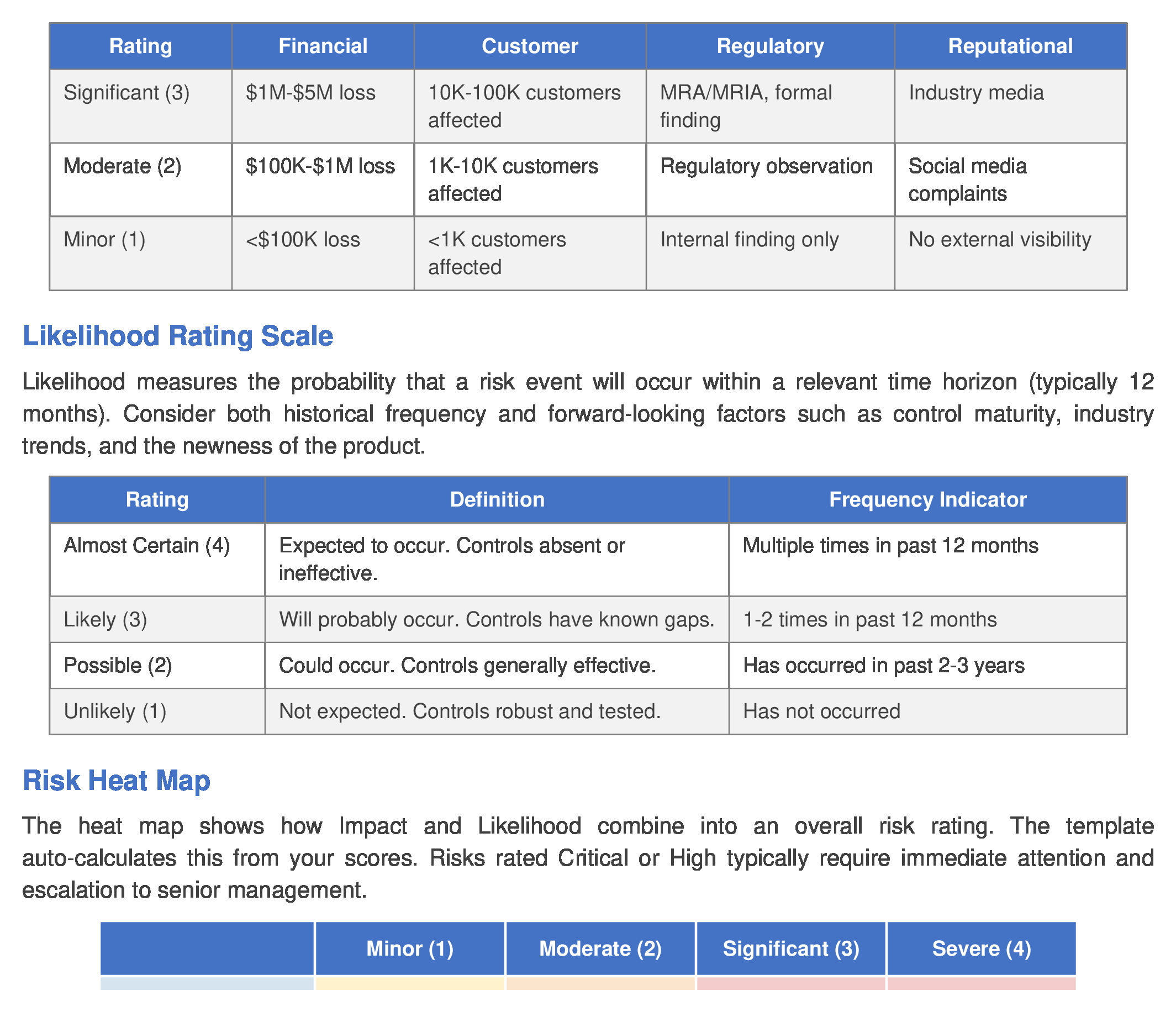
4×4 risk scoring matrix — Impact × Likelihood with financial, customer, regulatory, and reputational thresholds

4×4 risk scoring matrix — Impact × Likelihood with financial, customer, regulatory, and reputational thresholds

Pre-launch checklist sample — 58 items across 9 categories before going live

Pre-launch checklist sample — 58 items across 9 categories before going live

● Case file

When new product launches make the news for the wrong reasons

These public cases illustrate product, partner, disclosure, suitability, and regulatory-classification risks. They are prompts for review and scenario analysis, not proof that this template would have prevented a particular incident or outcome.

April 2024

Synapse Bankruptcy → Yotta, Juno, Copper Customer Funds Frozen

Synapse — the middleware connecting fintechs like Yotta, Juno, and Copper to sponsor banks (including Evolve) — filed Chapter 11 on April 22, 2024. The trustee discovered the ledger couldn't reconcile which customer was owed which dollars.

Why it mattersMiddleware failure is a new-product risk, not just a vendor risk. Yotta's launch should have stress-tested "what happens if the middleware files Chapter 11?" Map every dependency in the customer-funds path and document the wind-down plan before launch.

October 2023

Voyager Digital — FTC $1.65B Settlement on False FDIC Claims

Voyager marketed its crypto interest accounts with FDIC insurance and "safe deposit" treatment. The FDIC insurance covered cash at the bank, not the crypto — but materials conflated them. When Voyager filed Chapter 11 in July 2022, $1B+ of customer crypto was tied up.

Why it mattersMarketing language is a regulatory artifact. The new-product risk assessment must include legal and marketing review on disclosure accuracy — what the customer hears must match what the product delivers. "FDIC-insured" on the wrong asset is UDAAP before it's an FTC case.

June 2021

Robinhood — $70M FINRA Fine (Largest in FINRA History)

FINRA found Robinhood caused "widespread and significant harm": misleading account balances, deficient options-trading approvals, and outages from 2018-2021. The approval failures connected to 20-year-old Alex Kearns, who died in June 2020 after the app showed an inaccurate -$730,000 options balance.

Why it mattersCustomer-protection failures usually start as marketing and disclosure decisions made before launch. The Pre-Launch Checklist forces UDAAP review on marketing, fee disclosures, Reg E procedures, and trained support — all signed off before go-live. Every one would have flagged Robinhood's gaps.

If you're reading this trying to make sure your next launch doesn't end up on this list — that's exactly why the new product risk review process exists. Here's what you'd recognize:

◆ Good fit if any of these sound familiar

When teams reach for this template.

You're the first risk and compliance hire at your fintech — and there's a launch on the calendar with no documented review behind it.

The 4 worked examples (BNPL, Embedded Finance, Instant Payments, Stablecoins) give you a starting template you can adapt in days. The 5-question trigger decision tells you whether a full assessment is needed; the questionnaire and pre-launch checklist do the rest.

Your CEO wants to launch BNPL, embedded finance, instant payments, or stablecoins next quarter and risk hasn't started the assessment.

Start with the closest of the 4 populated examples, then replace its assumptions, risks, controls, and approvals with product-specific information.

Your last product launch shipped without a documented risk review — and now an examiner is asking why.

You can't retroactively run the assessment, but you can document a consistent process going forward. The submission template, risk register, and post-launch monitoring checklist provide a starting structure.

◆ Why now

Updated for the 2025–2026 BaaS, BNPL, and stablecoin enforcement wave

Fintech-bank partnerships, BNPL products, and stablecoins remain active areas of legal and regulatory change. The kit includes worked examples and review prompts for those product types, but requirements and effective dates depend on the product and jurisdiction. Confirm current primary sources and obtain legal or compliance review before making launch decisions.

◆ Where this fits

Where this fits in your product launch process

  • If you have an new product review committee — this gives them a standard submission template, scoring matrix, and worked examples so reviews are consistent and defensible across product types.
  • If you don't have an new product review committee yet — this is your week-one program. The 4 worked examples show what a complete risk assessment looks like; adapt one for your product and you have a starting point.
  • If you're working with a bank partner — use the populated assessment, scoring matrix, and post-launch monitoring plan to organize the information requested during due diligence.
  • If your last launch didn't have a formal new product risk review — use the kit to establish a documented process for future launches, with organization-specific governance and review.

◆ What this isn't

Setting expectations.

  • × Not a replacement for legal review — your counsel still reviews specific contractual, regulatory, and consumer-disclosure language for your product.
  • × Not a software platform — these are Excel + PDF templates, not a SaaS new product workflow tool.
  • × Not a substitute for a Chief Risk Officer or new product review committee chair — this is the toolkit they use, not a substitute for the role.
  • × Not theory — these are operational templates with 4 fully populated worked examples calibrated to the products examiners are scrutinizing right now.

◆ 30-day rollout plan

How to roll this out for your next launch

This sample 4-week sequence applies the process to a real launch, with suggested workshops, owners, and deliverables. Adjust timing and approvals to the product and organization.

  1. Week 1

    Trigger assessment + scoping workshop

    Run the 5-question new product trigger decision through the proposed product. If a full assessment is required, run a 60-minute scoping workshop with product, risk, compliance, legal, and engineering. Output: defined scope, risk types in play, target new product review committee date, owner assignments per risk category.

  2. Week 2

    Populate the multi-risk assessment

    Each risk owner completes their section of the questionnaire (credit, operational, compliance, legal, reputational, strategic). Use the worked example closest to your product (BNPL, Embedded Finance, Instant Payments, Stablecoins) as calibration. Output: populated risk assessment with inherent and residual scores by risk type.

  3. Week 3

    Pre-launch checklist + bank partner alignment

    Run the 58-item Pre-Launch Checklist across the 9 categories. Identify open items and owners. If you have a bank partner, share the risk assessment and scoring summary at the next due diligence touchpoint and capture their feedback. Output: complete checklist status, partner-feedback log.

  4. Week 4

    Committee submission + go/no-go decision

    Format the assessment output into the new product review committee submission template, brief the committee, capture the decision (Go / Conditional Go / No-Go) and any conditions. Set the post-launch monitoring cadence. Outcome: a documented launch decision your examiner, bank partner, and board can review with confidence.

◆ Full playbook in the PDF guide

The complete rollout including workshop agendas, attendee lists, and the decision-meeting brief format is in the PDF guide that comes with the template.

◆ Regulatory alignment

Aligned with 2024–2026 fintech-bank partnership enforcement landscape

The guide includes references intended to help reviewers trace relevant prompts. Confirm applicability and current primary-source text before relying on them:

  • OCC heightened standards for community banks ($500M+ assets)
  • Interagency Statement on BaaS-Type Activities (2023)
  • OCC Bulletin 2023-17 (interagency third-party risk management)
  • FDIC custodial deposit recordkeeping NPR (2025)
  • CFPB BNPL Interpretive Rule under Reg Z (2024)
  • GENIUS Act stablecoin requirements (signed July 2025)
  • CFPB UDAAP guidance on new product disclosure
  • FFIEC Retail Payment Systems IT Examination Handbook

Built for new product review committees, product risk teams, and compliance leads at fintechs, banks, and BaaS sponsors.

Last updated: May 1, 2026

◆ Template guide

New Product Risk Assessment Template Guide

How to run a New Product Risk Assessment: 12-category risk questionnaire, 4x4 impact and likelihood scoring, a 58-item pre-launch checklist, and the sign-off flow your risk committee and bank partner expect before go-live.

Read guide →

◆ FAQ

Frequently asked questions.

What are the 4 worked example assessments included?

The kit includes fully completed risk assessments for: BNPL (Buy Now Pay Later), Embedded Finance, Instant Payments, and Stablecoins. Each covers the specific risks, controls, and regulatory considerations for that product type — useful as a starting point if you're launching one of these, or as calibration examples for similar products.

What triggers the requirement for a full new product risk review?

The kit includes 5 decision questions that determine whether a product change or launch requires a full risk assessment vs. a lighter review. Generally, a full new product risk review is triggered by new credit exposure, new regulatory obligations, new third-party dependencies, products targeting new customer segments, or significant technology changes.

What's in the pre-launch checklist's 58 items?

The checklist spans 9 categories: Regulatory & Licensing, BSA/AML & Fraud, Consumer Protection & Compliance, Technology & Security, Data Privacy, Third-Party / Vendor Management, Operational Readiness, Financial & Risk Management, and Governance & Documentation. Each item is tagged Required or Recommended and includes Status, Owner, and Notes / Evidence columns so you can track completion and document audit trail.

How does the risk committee submission flow work?

The template formats your risk assessment output as a Product Overview tab (executive summary, product description, key dependencies, target launch date), a Risk Register that aggregates the questionnaire findings into inherent and residual scores, and a Pre-Launch Checklist tied to sign-off rows for 1st-line, 2nd-line, and Risk Committee approval. You bring those four tabs to the committee meeting.

Does this cover all the risk types in a single assessment?

Yes. The Step 1 Risk Questionnaire covers 12 risk categories — Compliance, Regulatory, Operational, Technology, Fraud, Third-Party, Credit, Liquidity, Data/Privacy, Reputational, Strategic, and Model Risk — in a single document. Findings flow into a Risk Register with inherent and residual scoring per category that feeds the committee recommendation.

Can this be used for partnerships and distribution agreements, not just internal products?

Yes — the kit explicitly covers embedded finance and partnership-driven products. The risk assessment includes specific questions about partner obligations, liability allocation, regulatory responsibility, and how the partnership changes your own risk profile.

Can I share completed outputs externally?

Yes. You can use completed outputs with auditors, customers, bank partners, regulators, and internal stakeholders. Customize the template for internal business use — just don't resell or redistribute the source template files.

How do I receive the files?

Checkout is handled through Stripe. After purchase, you receive the template and guide download link immediately on the confirmation page and by email, along with your Stripe receipt. No account is required.

What if it's not a fit?

Email within 30 days for a full refund, no questions asked. The guarantee is meant to remove purchase risk while you evaluate whether the template fits your use case.
● First-time buyer offer

Get 20% off your first template.

Drop your email and we'll send the code.

◆ Not ready to buy?

Start with the free Risk Register.

141 pre-populated fintech risks across 21 categories. ISO 31000 structure.

Download free Risk Register →

◆ Related templates

Pairs well with.

Template
$69

Third-Party Risk Management (TPRM) Kit

Complete vendor risk management lifecycle from initial due diligence to ongoing oversight.

Template
$59

AI Risk Assessment Template & Guide

Comprehensive AI model governance and risk assessment templates for financial services teams.

Template
$49

Issues Management Tracker & Template

End-to-end issues tracking and remediation management for risk and compliance teams.

◆ Ready when you are

Get the New Product Risk Assessment.

Start building a defensible risk program today.

Buy & download — $59 →
Secure checkout Emailed access Fully editable 30-day money-back

Immaterial Findings · Newsletter

The brief, in your inbox.

Enforcement of the week, a framework breakdown, and the prompts that are actually worth running. Delivered to your inbox. Free.