Financial Risk Management Kit
Credit, liquidity, customer funds, payments losses, capital, interest rate and concentration risk for fintechs — with stress scenarios and a board-ready risk appetite statement.
Price
$59
One-time. No subscription. Use forever.
Delivered immediately after checkout — your template and guide links are emailed to you with your receipt.
Built for risk and compliance teams at financial-services organizations
◆ Quick buying summary
What you get and when you can use it
- Good fit if
- You're the compliance or finance lead who just inherited financial risk and needs a monthly process the CFO and board will use
- Format
- Editable workbook plus PDF/supporting guide materials where included. Instant download after checkout.
- Need the methodology first?
- Read the Financial Risk Management Template Guide.
- Time to value
- Start reviewing, editing, and assigning owners the same day; customize to your organization before sharing outputs externally.
- After purchase
- After payment, download every file immediately from the confirmation page. RiskTemplates also emails a secure access link, and Stripe sends the payment receipt separately. No account required.
◆ What's included
- ◆ Risk Appetite page: 21 linked metrics with calculated Green/Amber/Red status for the monthly committee
- ◆ Stress scenarios: six scenarios plus a base case — recession, rate shock, funding freeze, bank partner exit, processor reserve increase and combined severe — with net worth after 12 months of planned losses and what breaks first
- ◆ Credit risk from dollar balances: 30+/60+ delinquency, annualized net charge-offs, reserve coverage, illustrative benchmarks plus Federal Reserve reference data
- ◆ Credit economics: vintage loss curves, roll rates, allowance check, loss-adjusted margin by product
- ◆ Liquidity & runway: monthly and quarterly burn, runway with and without the facility, operating reserve check; cash at banks vs. the FDIC limit
- ◆ Settlement exposure by payment rail and a daily FBO / custodial reconciliation log
- ◆ Payments losses: Visa dispute + fraud ratio (VAMP), Nacha ACH return rates, processor reserves, merchant exposure
- ◆ Capital & net worth for non-banks: a balance sheet built from the other tabs, state money transmitter net worth, bond and permissible investments; lender and bank-partner covenants; interest rate sensitivity; concentration
- ◆ Board-ready appetite statement for 11 dimensions, committee log, and a 22-page guide
Use rights: customize for internal business use and use outputs with your auditors, customers, bank partners, and regulators. Do not resell or redistribute the template files.
◆ Preview
See what the template covers.
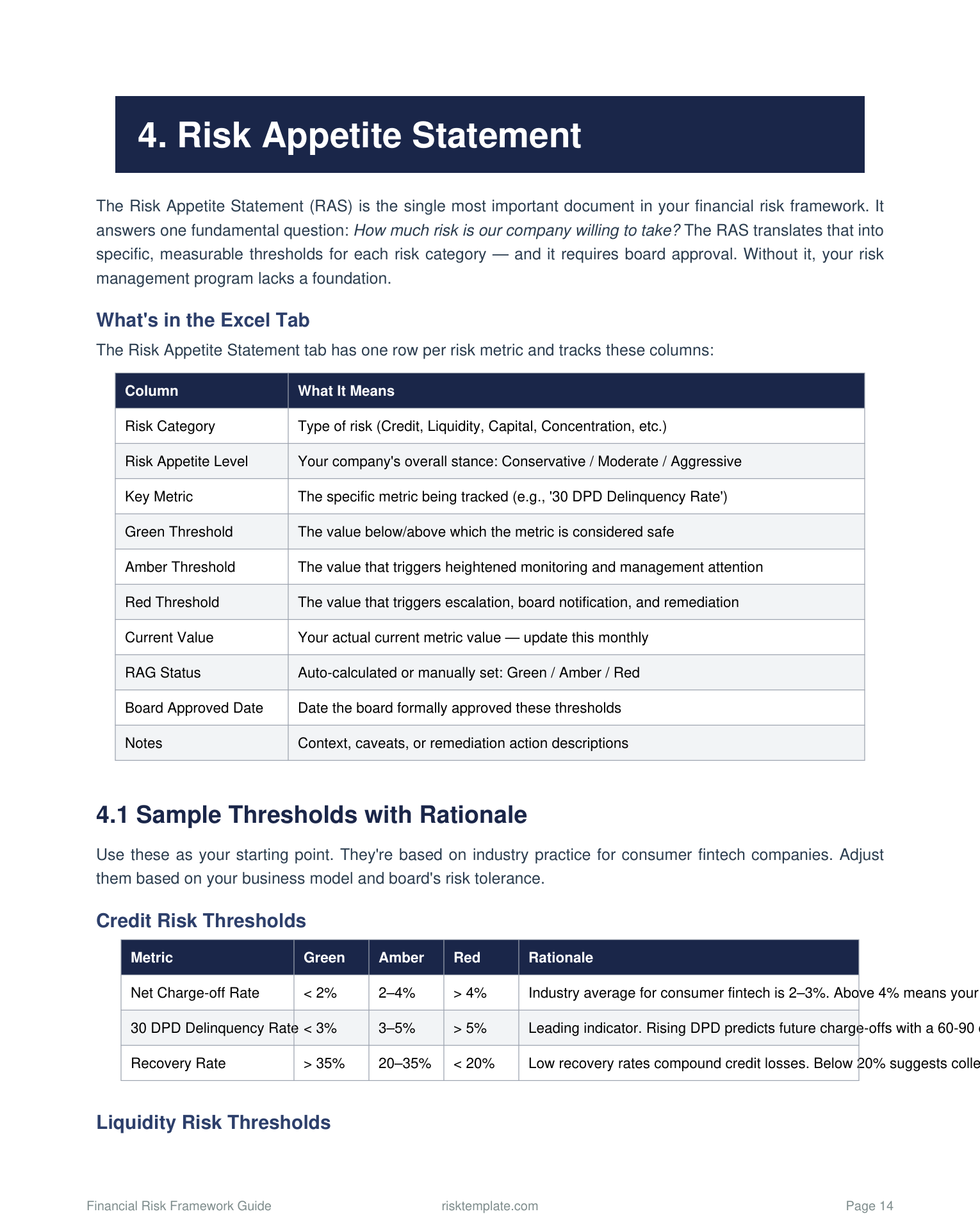
Risk Appetite page — 21 metrics linked to their source tabs with calculated Green/Amber/Red status
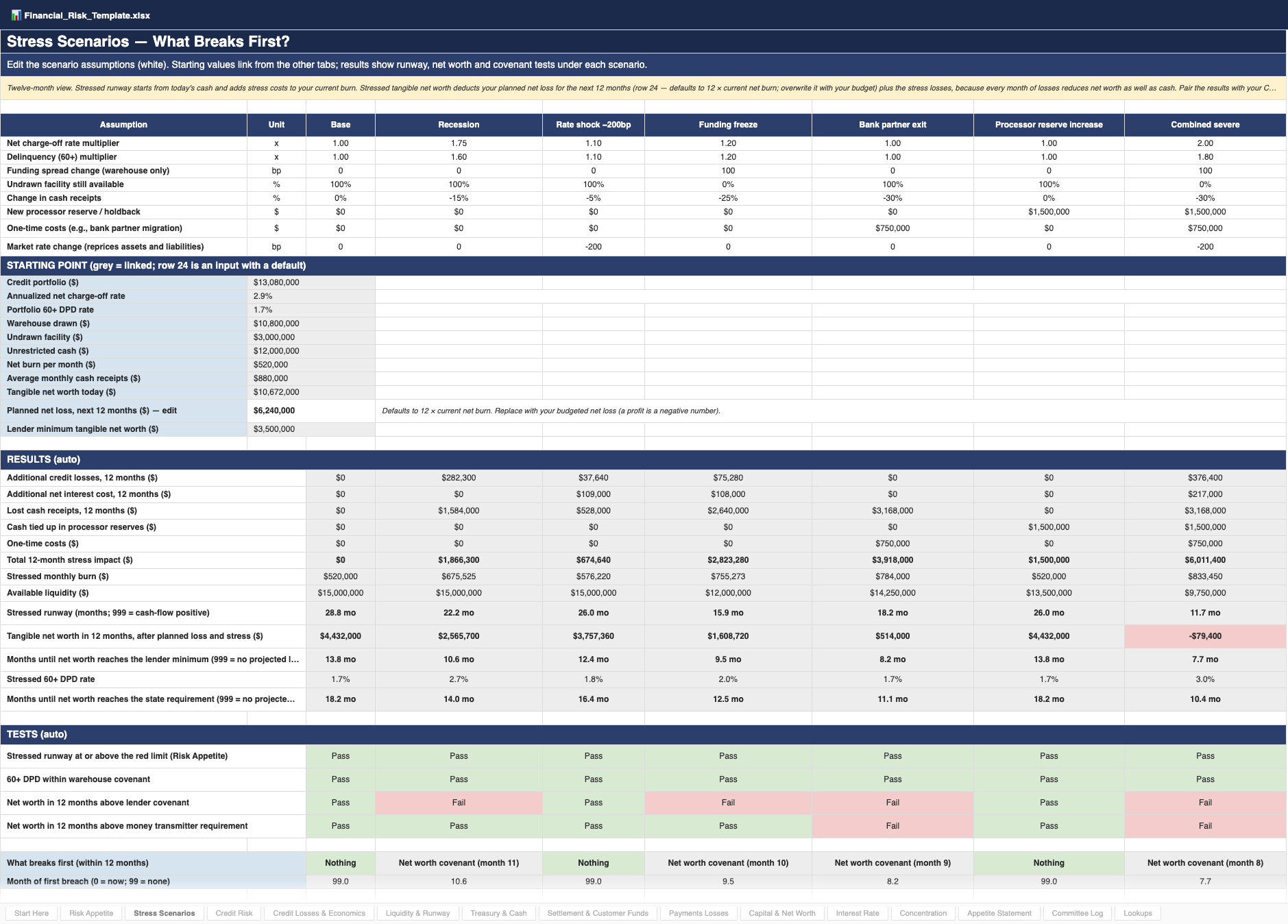
Stress scenarios — six scenarios plus a base case applied to live numbers, with runway, net worth after planned losses, covenant tests and what breaks first
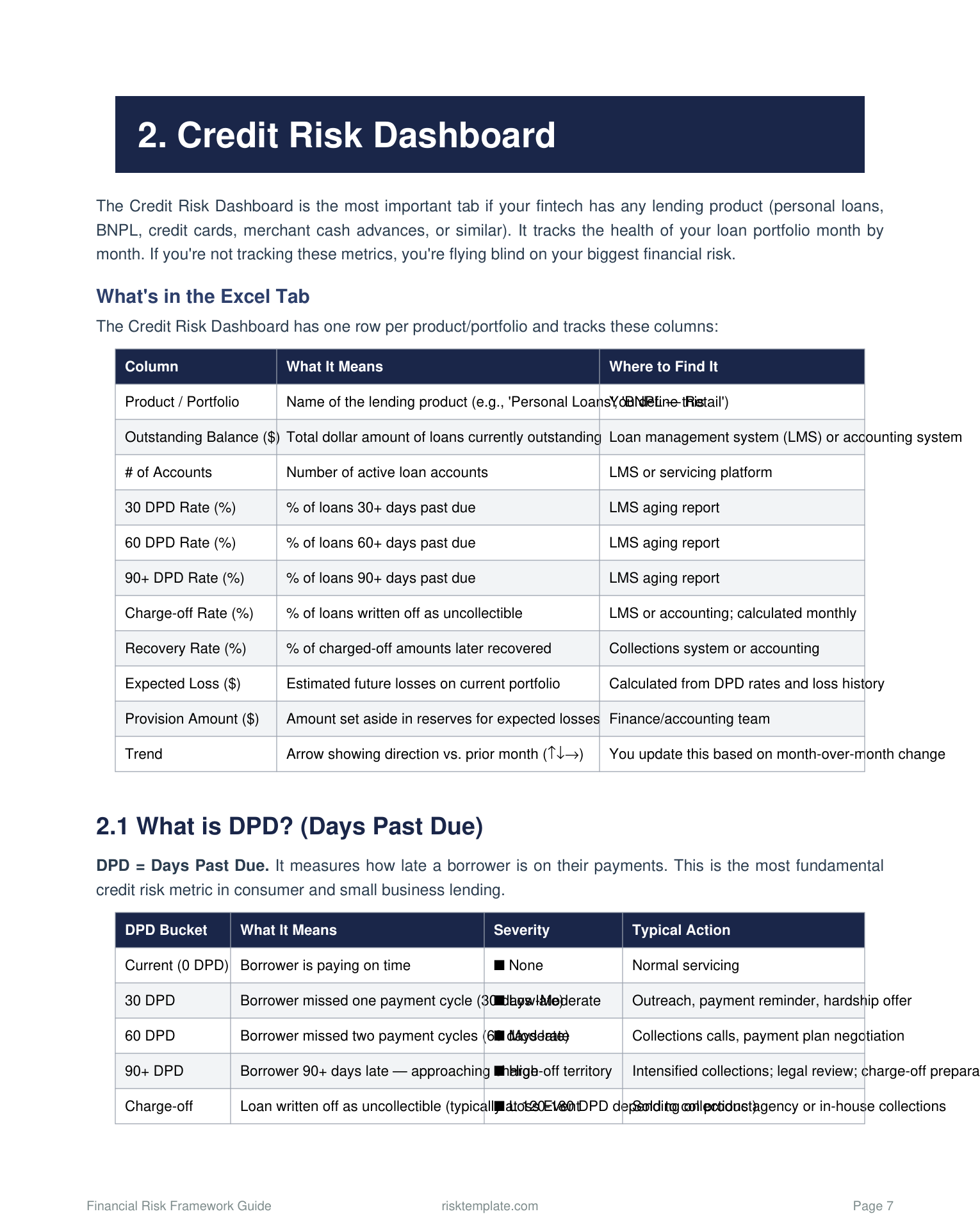
Credit risk dashboard — delinquency and annualized charge-offs by product from dollar balances, checked against benchmark thresholds
◆ Template guide
Financial Risk Management Template Guide
How to build a financial risk management template for fintechs: credit risk by product from dollar balances, liquidity and runway, customer-funds reconciliation, state money transmitter net worth, concentration limits, stress scenarios, and a board-approved risk appetite.
◆ FAQ
Frequently asked questions.
What credit benchmarks are included?
Each product is assigned a benchmark type — prime or nonprime personal loans, credit cards, BNPL, small business loans, merchant cash advance, auto, earned wage access or other — with editable Green and Red thresholds for 30+ day delinquency and annualized net charge-offs. The thresholds are illustrative starting points to calibrate to your own credit box, shown beside published Federal Reserve delinquency and charge-off rates (Q2 2026) for context.
What does the liquidity tab calculate?
Monthly and quarterly net burn from the last three months of expenses and receipts, runway from unrestricted cash with and without your undrawn facility, current and quick ratios, and a minimum operating reserve (months of expenses) with surplus or shortfall. Each metric is checked against your limits. A separate Treasury & Cash tab shows how much operating cash is uninsured at each bank.
What do the stress scenarios do?
They run six stress scenarios plus a base case — recession, a ±200bp rate shock run through your repricing gap, funding freeze, bank partner exit, processor reserve increase and a combined severe case — on your live numbers. For each, the tab shows 12-month stress costs, stressed runway, tangible net worth after your planned 12-month losses plus the stress, the months until net worth reaches your lender's minimum, and stressed delinquency. It tests them against your stressed-runway limit, lender covenants and the state net worth requirement, and names the earliest-dated breach. In the sample, cash never breaks first — the net worth covenant does, and the combined severe case ends the year with negative net worth. The assumptions are editable.
What does the risk appetite statement include?
Board-ready sample wording for 11 dimensions: purpose and scope, credit loss, liquidity, capital and net worth, concentration, funding, settlement and customer funds, operational and fraud losses, interest rate, payments losses, and stress resilience. The limits in the text are formulas that read the Risk Appetite tab, so the statement and the monitoring always match.
Is this useful for a payments company that doesn't lend?
Yes. Settlement exposure by payment rail, the daily customer-funds reconciliation, Visa dispute-and-fraud and Nacha return-rate monitoring, processor reserves, merchant exposure, treasury, money transmitter net worth and the stress scenarios all apply to payments businesses. The credit tabs can be left empty.
Does it apply bank capital rules to a fintech?
No. Bank capital ratios don't apply to non-banks. The Capital & Net Worth tab covers what does: tangible net worth from a balance sheet that ties to the other tabs, the state money transmitter net worth, surety bond (including the optional $100,000 bond some states adopt) and permissible-investment tests using the Conference of State Bank Supervisors (CSBS) model-law formulas, and lender and bank-partner covenants. Bank ratios appear only as a reference block for monitoring your partner bank against the well-capitalized thresholds.
Can I share completed outputs externally?
Yes. You can use completed outputs with auditors, customers, bank partners, regulators, and internal stakeholders. Customize the template for internal business use — just don't resell or redistribute the source template files.
How do I receive the files?
Checkout is handled through Stripe. After payment, download every file immediately from the confirmation page. RiskTemplates also emails a secure access link, and Stripe sends the payment receipt separately. No account is required.
What if it's not a fit?
Email within 30 days for a full refund, no questions asked. The guarantee is meant to remove purchase risk while you evaluate whether the template fits your use case.
● First-time buyer offer
Get 20% off your first template.
Drop your email and we'll send the code.
◆ Not ready to buy?
Start with the free Risk Register.
141 pre-populated fintech risks across 21 categories. ISO 31000 structure.
Download free Risk Register →◆ Related templates
Pairs well with.
Enterprise Risk Management Framework (ERMF)
Complete ERM documentation: risk appetite, 3 Lines of Defense, committee charter, and board reporting.
Loss Monitoring & Event Tracking Kit
Operational loss and near-miss tracking for fintechs — with automatic escalation tiers, bank-partner notice flags and a dashboard that calculates itself.
KRI Library (152 Key Risk Indicators)
152 KRIs — including 20 emerging-risk KRIs for AI-enabled fraud, scams and AI governance — with thresholds, owners and a calculating dashboard.
◆ Ready when you are
Get the Financial Risk Management Kit.
Start building a defensible risk program today.