RiskTemplates · The Daily Brief Monday, May 25, 2026
Template Updated May 2026

Fintech Customer AUP Kit

Acceptable Use Policy framework for fintech compliance teams evaluating high-risk customers and merchants.

Price

$79

One-time. No subscription. Use forever.

Buy now →
Secure checkout Emailed access Fully editable 30-day money-back

Delivered immediately after checkout — your template and guide links are emailed to you with your receipt.

Used by compliance teams at banks, fintechs, and asset managers

◆ Quick buying summary

What you get and when you can use it

Good fit if
You're building or upgrading a fintech AUP and need the operational backbone, not just a policy paragraph
Format
Editable workbook plus PDF/supporting guide materials where included. Instant download after checkout.
Time to value
Start reviewing, editing, and assigning owners the same day; customize to your organization before sharing outputs externally.
After purchase
After checkout, your templates and guides are available immediately and the download link is sent to your email with your Stripe receipt. No account required.

◆ What's included

  • 16-tab Excel workbook (213 formulas, 10 data validations, 15 conditional formatting groups)
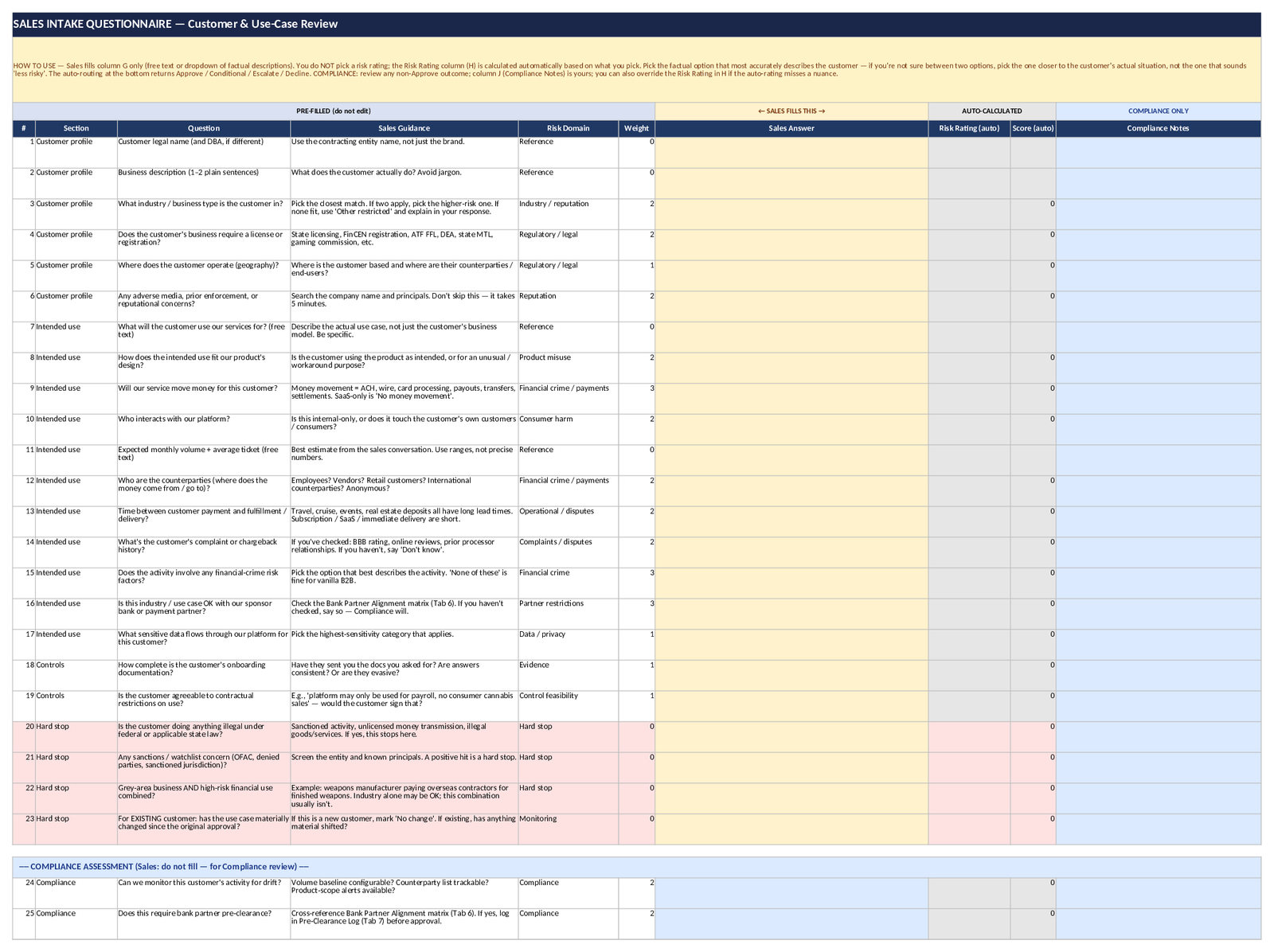
  • Sales Intake Questionnaire — 22 weighted questions, auto-routes to Approve / Conditional / Escalate / Decline
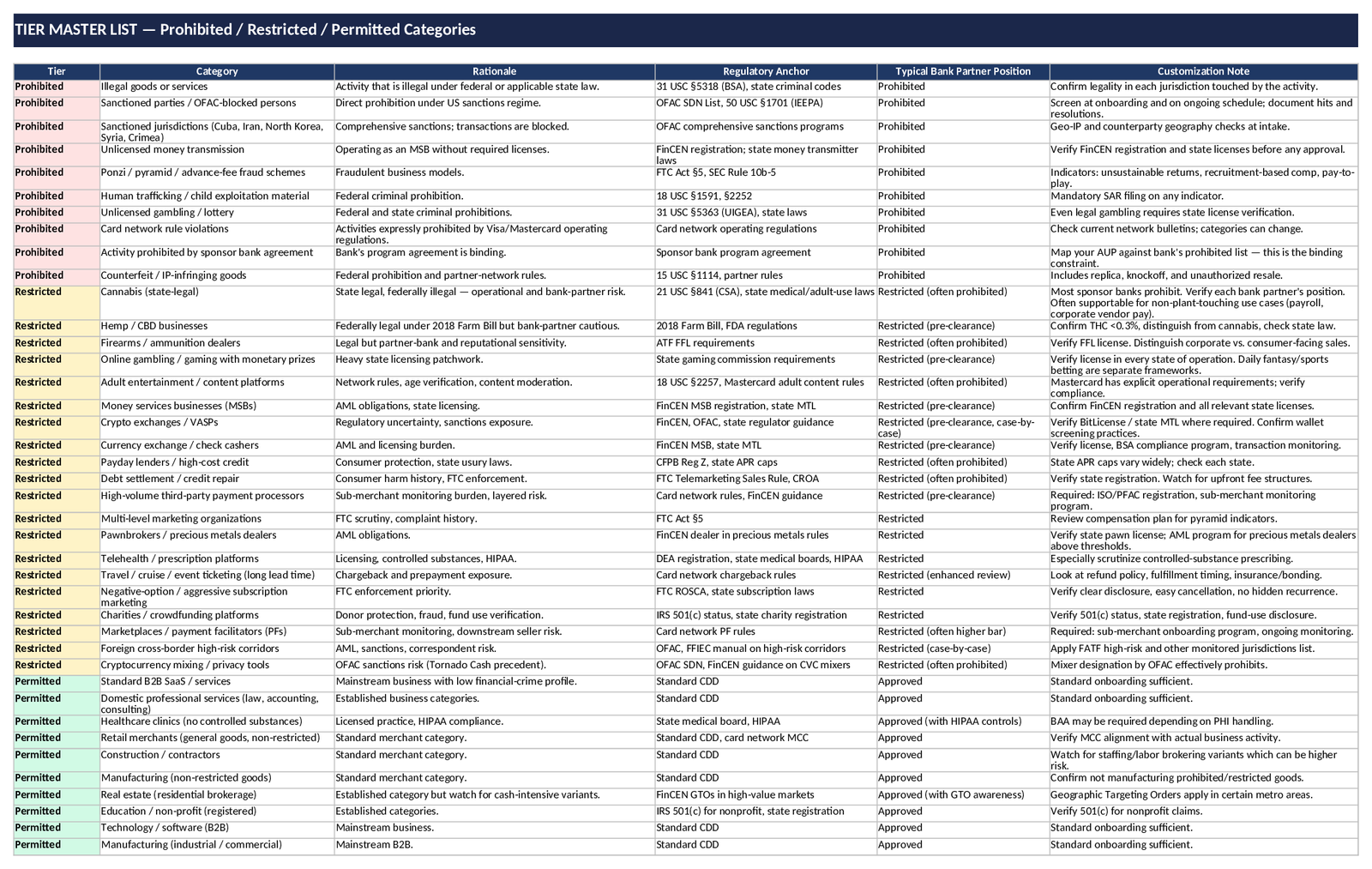
  • Tier Master List — 40 categories across Prohibited / Restricted / Permitted, each with regulatory anchor and typical bank partner position
  • Bank Partner Alignment Matrix — your AUP vs sponsor bank, gap-flagged with formulas
  • Pre-Clearance Log with SLA tracking
  • 10-section fillable Exception Memo template

Use rights: customize for internal business use and use outputs with your auditors, customers, bank partners, and regulators. Do not resell or redistribute the template files.

◆ Preview

See what the template covers.

Download now — $79 →
Sales Intake Questionnaire tab — 22 factual-options dropdowns, Sales picks customer descriptions, Risk Rating auto-calculates via formula. Yellow = Sales input. Blue = Compliance-only. Auto-routes to Approve / Conditional / Escalate / Decline.

Sales Intake Questionnaire tab — 22 factual-options dropdowns, Sales picks customer descriptions, Risk Rating auto-calculates via formula. Yellow = Sales input. Blue = Compliance-only. Auto-routes to Approve / Conditional / Escalate / Decline.

Tier Master List — 40 customer categories classified as Prohibited / Restricted / Permitted, each with rationale, regulatory anchor (OFAC, FinCEN, OCC, CSA, etc.), and typical sponsor-bank position

Tier Master List — 40 customer categories classified as Prohibited / Restricted / Permitted, each with rationale, regulatory anchor (OFAC, FinCEN, OCC, CSA, etc.), and typical sponsor-bank position

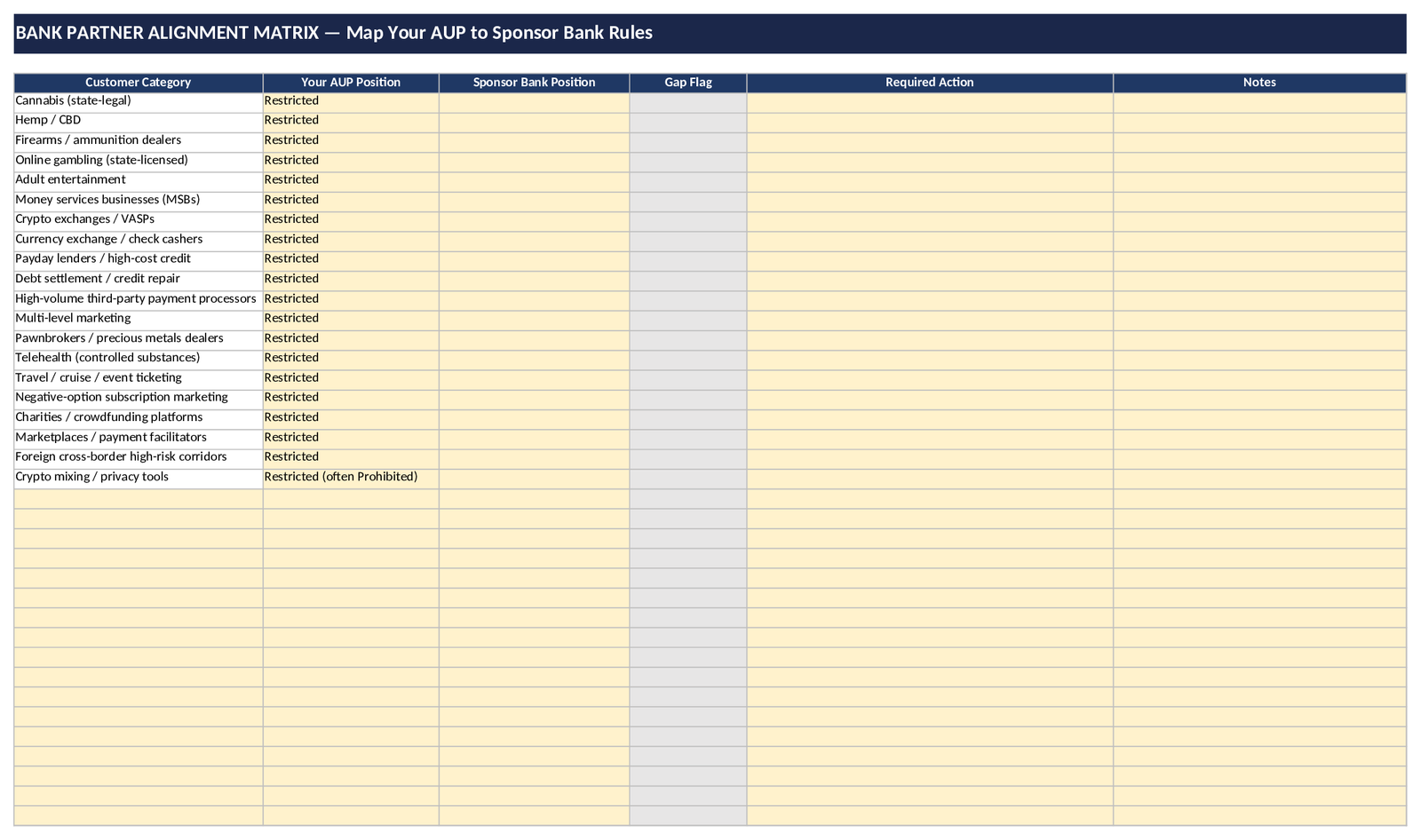
Bank Partner Alignment Matrix — your AUP vs. sponsor bank position for 20+ restricted categories, with formula-driven Gap flagging (Aligned / Gap / Material Gap)

Bank Partner Alignment Matrix — your AUP vs. sponsor bank position for 20+ restricted categories, with formula-driven Gap flagging (Aligned / Gap / Material Gap)

● Case file

The 2024 BaaS enforcement cycle made this a structural problem

A material share of 2024 federal banking enforcement actions targeted sponsor banks in embedded finance / BaaS arrangements. The common thread reported in those actions: the bank's oversight had not kept pace with the volume and complexity of fintech activity on its charter. AUP-bank alignment is the structural fix.

2024

Blue Ridge Bank — OCC consent order, BaaS program exit

OCC consent order cited BSA/AML failures tied to inadequate oversight of fintech programs.

Why it mattersA fintech AUP that does not map to the sponsor bank's rules is a fintech AUP that may not survive contact with the bank's next program review.

2024

Evolve Bank & Trust — Federal Reserve cease-and-desist

Failure to maintain an effective risk management framework for fintech partnerships; inadequate ongoing oversight and monitoring of those relationships.

Why it mattersThe enforcement was not about the initial approvals. It was about failure to monitor after approval — which the Monitoring Trigger Library and Re-Review Calendar are built to prevent.

2024

TD Bank — $3.1B FinCEN/OCC/DOJ resolution

Largest BSA enforcement action in US history. The order documented backlogs of customers to be exited that "presented unacceptable AML risk" — customers whose ongoing activity had crossed into high-risk territory but were never off-boarded.

Why it mattersExit triggers defined in advance and documented per-customer in the Exception Memo — not improvised at the moment of crisis — are the structural answer.

Every documented decision in this kit produces a defensible record — for the next exam, the next bank partner review, or the next time an exit decision needs to be defended on criteria-based grounds.

◆ Why now

Why now: the structural gap between fintech AUPs and sponsor bank rules

The 2024 enforcement cycle showed that a fintech AUP that is not mapped to the sponsor bank's program agreement is operationally fragile. The Aug 2025 Debanking EO added a second pressure: exits must be criteria-based and documented in advance. FinCEN's CDD framework requires ongoing monitoring commensurate with customer risk. These three currents make a documented, tiered, bank-partner-aligned AUP program a current-cycle priority — not a year-three nice-to-have.

◆ Regulatory alignment

Built to the 2026 fintech regulatory environment

This kit was built to operationalize the documented compliance expectations applicable to BaaS fintech programs in 2026.

  • 2024 Interagency Joint Statement on Bank-Fintech Arrangements
  • OCC Bulletin 2023-17 (Interagency Third-Party Risk Management)
  • FinCEN CDD Final Rule (31 CFR §1020.210) — risk-based ongoing monitoring
  • OCC consent order practice — Blue Ridge, Evolve, Piermont, Sutton, Thread, Lineage
  • August 2025 Executive Order on Fair Banking Access (debanking)
  • FFIEC BSA/AML Examination Manual — Customer Due Diligence
  • Card network operating regulations (Visa, Mastercard)
  • OFAC sanctions framework
  • FATF high-risk jurisdictions list

Last updated: May 24, 2026

◆ 30-day money-back guarantee

Try it. If it doesn't fit, we refund.

If this template doesn't meet your expectations, email us within 30 days for a full refund. No questions asked.

◆ Template guide

Fintech Customer Acceptable Use Policy Template Guide

How to build a fintech Acceptable Use Policy: sales intake questionnaire, three-tier customer classification (Prohibited / Restricted / Permitted), bank-partner alignment matrix, exception memo, and post-approval monitoring triggers.

Read guide →

◆ Usage, access, and purchase details

The fine print, in plain English.

Can my team customize it?

Yes. The template is intended to be edited for your internal business use and adapted to your controls, owners, products, vendors, and evidence.

Can I share outputs externally?

Yes. You can use completed outputs with auditors, customers, bank partners, regulators, and internal stakeholders. Do not resell or redistribute the source template files.

How do I receive it?

Checkout is handled through Stripe. After purchase, you receive the template and guide download link immediately on the confirmation page and by email, along with your Stripe receipt. No account is required.

What if it's not a fit?

Email within 30 days for a refund. The guarantee is meant to remove purchase risk while you evaluate whether the template fits your use case.
◆ FAQ

Frequently asked questions.

How is this different from a generic AUP template?

A generic AUP gives you a list of prohibited industries. This kit gives you the operational backbone: a Sales-facing intake questionnaire that auto-routes deals (so Sales velocity stays intact), a documented approval path (so reviews don't get improvised), a Bank Partner Alignment matrix (because your sponsor bank's rules are the binding constraint), an Exception Memo template with the 10 elements an examiner expects, a post-approval monitoring library with default thresholds, and a populated Worked Example showing the full lifecycle. The PDF guide includes 28 drop-in policy paragraphs you can paste into your own AUP document.

Do I have to run every customer through this?

No — and that's the point. The Sales Intake Questionnaire is designed so 80–90% of standard deals get an "Approve" output and proceed to onboarding without compliance review. Only deals that score Conditional / Escalate / Decline route to Compliance. The structured questions ensure that when a deal does need a deeper look, Sales has captured the right facts up front — Compliance doesn't re-ask the same questions.

Is this fintech-specific or for banks too?

This v1 is built for fintechs (BaaS programs, sponsor-bank arrangements, payment platforms). The bank-partner alignment, RFI KRI tracker, and the regulatory anchor all reflect the 2024 BaaS enforcement cycle and the Aug 2025 Debanking EO. A banks edition (correspondent-bank-focused, card-network-aligned) is planned separately.

What does the worked example show?

GreenLeaf Payroll — a fictitious licensed Colorado cannabis retailer that wants to use the platform for payroll only (no consumer cannabis sales touch the platform). The example walks through: Sales Intake Questionnaire output, Compliance EDD findings, sponsor bank pre-clearance with conditions (cap, license re-verification, notification), the populated Exception Memo, monitoring baselines set at approval, a six-month volume-drift trigger event with documented investigation and memo update, and the annual re-review with cap increase. Every artifact in the kit is populated so you can see the full lifecycle.

How does the Bank Partner Alignment Matrix work?

For each of 20+ seeded restricted categories, you enter your AUP position (Prohibited / Restricted / Permitted) and your sponsor bank's position (from the program agreement). The Gap column auto-calculates: Aligned (positions match), Gap (positions differ — manageable direction), or Material Gap (your AUP is more permissive than the bank's — the dangerous direction). Material Gaps must be addressed before any further onboarding in that category. The matrix is reviewed annually and whenever the bank updates its program requirements.

Does the kit include the Exception Memo template?

Yes — Tab 8 of the workbook. The memo has 10 sections matching the FFIEC BSA/AML manual's EDD documentation expectations: Customer Identification, Business Category & AUP Classification, Platform Use & Transaction Types, Fund Flow Description, Prohibited/Restricted Analysis, Applicable Controls, Monitoring Plan & Review Schedule, Bank Partner Status, Approval & Sign-Off, and Exit Triggers. The memo is fillable; one customer per memo. The Worked Example tab shows how a populated memo looks.

How does the RFI Volume KRI Tracker work?

Track monthly RFIs from your sponsor bank by customer category. The workbook auto-calculates cumulative YTD and a Rising / Stable trend indicator (formula-based comparison to 3-month average). Rising RFI volume in a specific category is the structural early warning of bank partner discomfort — the pattern that preceded the 2024 BaaS consent orders. Escalate Rising trends to TPRM governance before they become formal warnings.

How does this fit with KYC and AML programs?

The AUP decides whether the customer or activity is eligible. KYC/CDD decides how closely you review the relationship. Transaction monitoring decides what you flag in ongoing activity. This kit is the AUP layer — it tells you whether you should onboard the customer at all, and what conditions and monitoring apply if you do. KYC/CDD and transaction monitoring sit downstream.

● First-time buyer offer

Get 20% off your first template.

Drop your email and we'll send the code.

◆ Not ready to buy?

Start with the free Risk Register.

141 pre-populated fintech risks across 21 categories. ISO 31000 structure.

Download free Risk Register →

◆ Related templates

Pairs well with.

Template
$69

Third-Party Risk Management (TPRM) Kit

Complete vendor risk management lifecycle from initial due diligence to ongoing oversight.

Template
$79

Contingency Funding Plan — Fintechs

Contingency funding plan for sponsor-bank fintechs — FBO reconciliation, runway-based triggers, post-Synapse stress scenarios.

Template
$49

KRI Library (132 Key Risk Indicators)

132 KRIs with thresholds, data sources, and escalation triggers pre-built for financial services.

◆ Ready when you are

Get the Fintech Customer AUP Kit.

Start building a defensible risk program today.

Buy — $79 →
Secure checkout Emailed access Fully editable 30-day money-back

Immaterial Findings · Newsletter

The brief, in your inbox.

Enforcement of the week, a framework breakdown, and the prompts that are actually worth running. Delivered to your inbox. Free.